Vietnam Tax Residency: The 183-Day Test Explained
You're a Vietnam tax resident if present 183 days or more in a calendar year or any 12 consecutive months from arrival, or have a registered residence or a home rented on a fixed-term lease. Residents are taxed on income from inside and outside Vietnam; non-residents only on income arising here, with wages at a flat 20%.
On this page
Say you land in Da Nang in March and don’t leave the country again for the rest of the year. By the time you’ve been present in Vietnam for 183 days or more within that calendar year, you’ve met the first test for Vietnamese tax residency — the same test also runs on any 12 consecutive months starting from your first day in the country, not only the calendar year. The count runs day by day: your day of arrival is one day, your day of departure is one day, and if you fly in and out again on the same day, the law counts that as a single day too.

.jpg)
The law behind this test
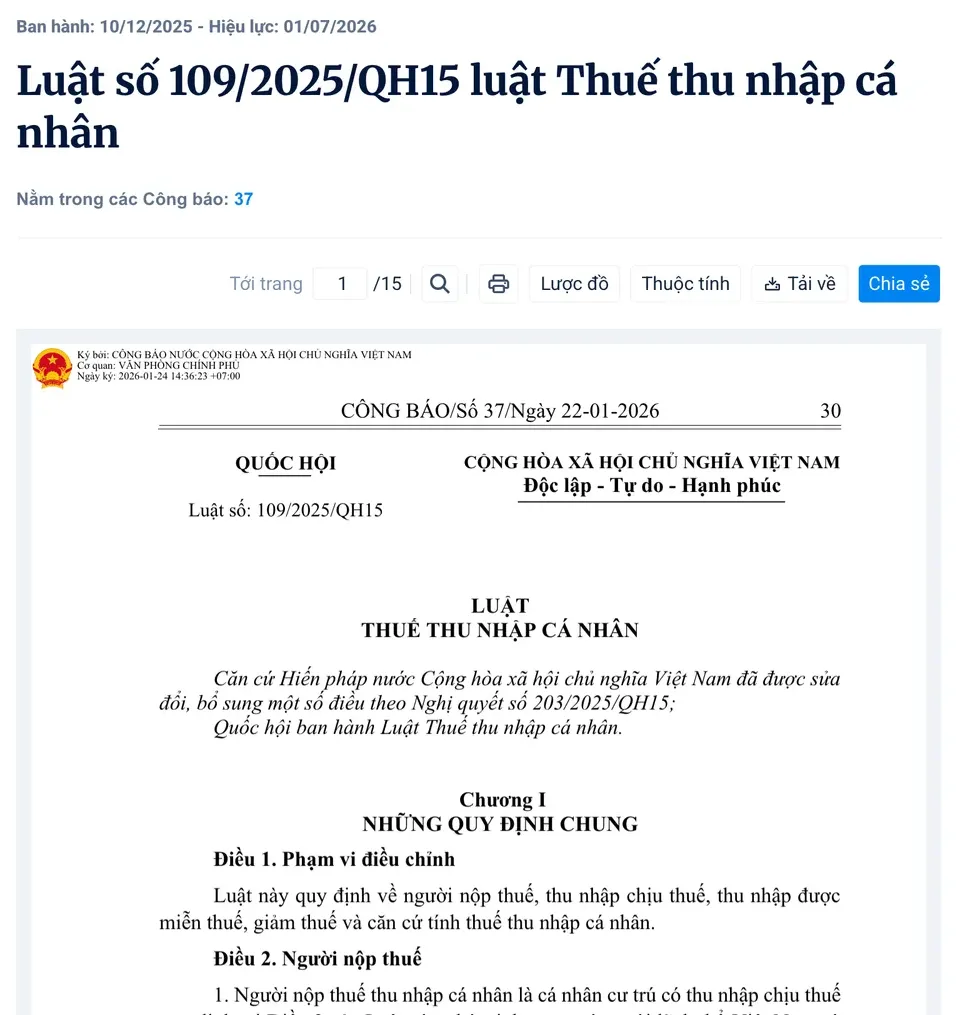
Vietnam’s tax-residency rules sit in the Personal Income Tax Law — as of today, that’s Law 109/2025/QH15, which took effect on 1 July 2026, replacing the old Personal Income Tax Law 04/2007/QH12 (as amended over the years). The provisions on business income, and on wages and salaries of a resident individual, specifically apply from the 2026 tax period.
Test two: having a “regular residence” in Vietnam
The second way to become a resident individual doesn’t depend on counting days at all: it’s having a “regular residence” in Vietnam — a registered permanent residence, or a home rented under a lease with a fixed term. For a foreigner, that registered residence is the address on your Permanent Residence Card, or the address you declared when applying for a Temporary Residence Card. See Temporary Residence Card in Vietnam for how that card itself works, and Temporary Residence Registration in Vietnam for the separate requirement to register where you’re staying with local authorities.
A rented home counts the same way even without one lease that covers the whole year: what matters is the total number of days across your lease agreement(s) in the tax year, and 183 days or more counts, even if you rented in more than one place. And if you do have a regular residence in Vietnam but were actually present for fewer than 183 days in the tax year, you’re still treated as a resident individual, unless you can prove you’re a tax resident of another country.
What changes once you know your status
Once you’re a resident individual, Vietnam taxes your income arising both inside and outside the country — not only what you earn locally. Wages and salaries are taxed on a progressive schedule with five brackets:
| Taxable income per year (million VND) | Rate |
|---|---|
| Up to 120 | 5% |
| Over 120 to 360 | 10% |
| Over 360 to 720 | 20% |
| Over 720 to 1,200 | 30% |
| Over 1,200 | 35% |
Fall on the non-resident side instead — meaning you meet neither the days test nor the regular-residence test — and Vietnam only taxes income arising within the country. For wages and salaries specifically, that’s a flat 20% on the total pay you receive for work performed in Vietnam, no matter where in the world you’re actually paid.
Tax treaties can change what you owe
Vietnam’s rules do account for double taxation: personal income tax you’ve already paid abroad, in a country that has signed a double-tax avoidance agreement with Vietnam, is credited against what you owe in Vietnam under that same agreement. This article doesn’t cover any specific country’s treaty terms — check your own country’s agreement with Vietnam for how the credit works in your case.
Registering a tax code as a foreigner
If you have business activity or income arising in Vietnam as a foreigner, you’re a taxpayer under Vietnamese tax law. If you register directly with the tax authority, the deadline for first-time tax registration is 10 working days from the date your personal income tax obligation arises.
This isn’t tax advice
This article sets out what Vietnam’s Personal Income Tax Law says, not advice about your own tax situation. Read it as the rule, then check your own facts — how many days you were actually present, what kind of home you have here — against it.
More money guides: opening a bank account in Vietnam as a foreigner, driving in Vietnam as a foreigner, and the money hub.
Common questions
If I'm in Vietnam for 183 days, am I automatically a tax resident?
Yes. Being present in Vietnam for 183 days or more in a calendar year, or across any 12 consecutive months from your first day here, is one of the two residency tests. Your arrival day and your departure day each count as a full day, and entering and leaving on the same day counts as one day.
Does renting an apartment in Da Nang make me a tax resident even if I travel a lot?
It can: the second residency test is having a 'regular residence' in Vietnam — a registered residence, or a rented home under a fixed-term lease. For a rented home, what counts is the total number of days across your lease agreement(s) in the tax year: 183 days or more, even across more than one place.
I have a place to live here but I'm actually in the country less than 183 days a year — am I still a resident?
Possibly yes. If you have a regular residence in Vietnam but were present for fewer than 183 days in the tax year, the law still treats you as a resident individual, unless you can prove you're a tax resident of another country.
What income does Vietnam tax once I'm a resident?
Income arising both inside and outside Vietnam. Wages and salaries are taxed on a progressive schedule of five brackets, from 5% to 35%.
What tax rate applies if I'm not a Vietnam tax resident?
A flat 20% on wages and salaries for work performed in Vietnam, no matter where or by whom you're paid — applied only to income arising inside Vietnam, not the resident's progressive brackets.
Can a tax treaty change what I owe in Vietnam?
Yes: personal income tax you've already paid abroad, in a country that has signed a double-tax avoidance agreement with Vietnam, is credited against what you owe in Vietnam under that agreement. This article doesn't cover any specific country's treaty terms.
Do I need to register a tax code as a foreigner, and by when?
A foreigner with business activity or income arising in Vietnam is a taxpayer under Vietnamese tax law. If you register directly with the tax authority, first-time registration is due within 10 working days of the date your personal income tax obligation arises.
Next in Money & admin
General information checked against the sources listed above, not legal advice for your situation. Rules and office practice change; confirm with the immigration office or a licensed adviser before you act. See how guides are checked.
Spotted an error? Report it.