How to Open a Bank Account in Vietnam as a Foreigner (2026)
A foreigner needs a passport or other foreign-issued identity document; one residing in Vietnam must also show an entry visa, a visa-equivalent document or visa-exemption proof, and a Temporary Residence Card counts as visa-equivalent. The bank warns you 30 days before those papers expire and suspends payments and withdrawals once they have.
On this page
One document decides whether a Vietnamese-dong payment account is available to you as a foreigner at all, and what happens to it later: Circular 17/2024/TT-NHNN, the State Bank of Vietnam’s rule on opening and using payment accounts, as amended by Circular 25/2025/TT-NHNN.
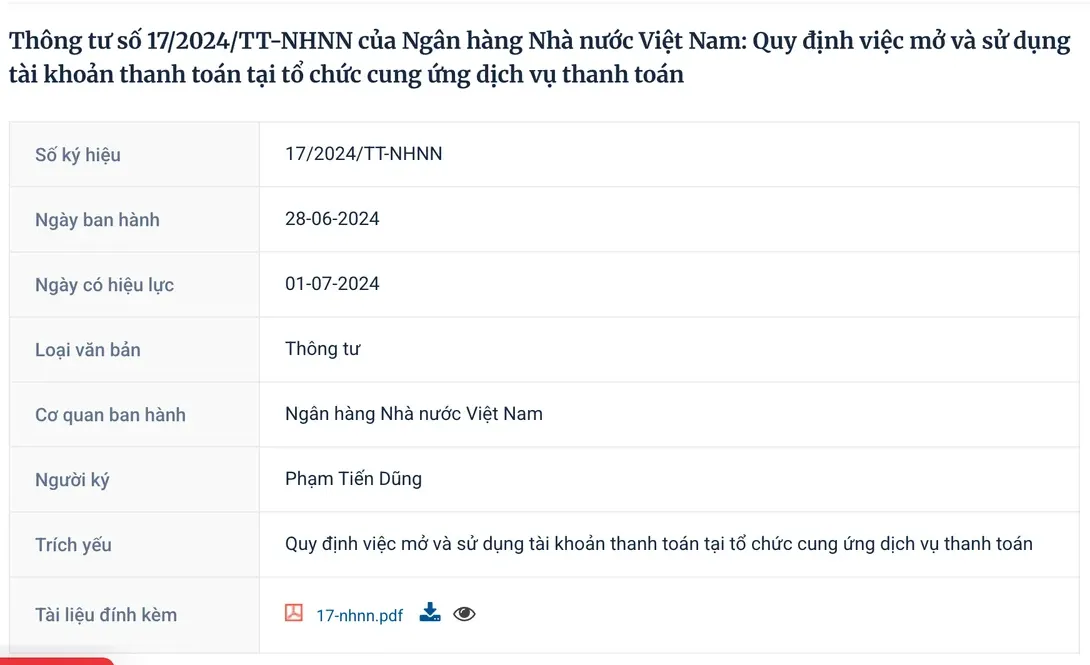
The opening and use of foreign-currency payment accounts of residents and non-residents, and of Vietnamese-dong payment accounts of non-residents and of resident foreigners, follow the law on foreign exchange management together with this Circular.
Resident or non-resident — which one are you?
A foreigner permitted to reside in Vietnam for 12 months or longer is a resident. If you’re in Vietnam to study, receive medical treatment, or travel, or you work for a foreign diplomatic mission, consulate, a representative office of an international organisation, or a representative office of a foreign organisation in Vietnam, you’re not a resident regardless of how long you stay. Anyone who doesn’t fall under that resident definition is a non-resident.
This test decides which foreign-currency and dong-account rules apply to you further down this page — it’s a separate question from tax residency, covered on the tax residency page.
Documents the bank needs from you
For an individual client who is a foreigner, the file must contain a passport, or another identity-proving document issued by a competent foreign authority; if you reside in Vietnam, you must additionally have an entry visa, a document with visa-equivalent value, or proof that you’re exempt from a visa. A Temporary Residence Card is defined as valid in place of a visa, so it satisfies that same line on the checklist — as would proof of an e-visa or of a visa exemption.
The account record itself has to carry more than the opening documents: your full name, date of birth, nationality, occupation or position, phone number, your passport number or foreign-issued identity information along with its issue date, issuing place and expiry date, your foreigner identification number if you have one, your entry-visa number or the number of the document substituting it (unless you’re visa-exempt), your address of residence abroad and the address you registered in Vietnam if you reside here, and whether you’re classed as a resident or a non-resident. Registering an address in Vietnam is its own step — see temporary residence registration for who files it and by when.
The people who can open a payment account at a bank or foreign bank branch include anyone aged 15 or older who isn’t restricted in, or deprived of, civil-act capacity under Vietnamese law.
Does the account outlive your visa?
The bank must track the validity period of your identity papers, and those of anyone else linked to the account, for as long as the payment account is in use. It must notify you at least 30 days before your identity paper’s expiry date so you can update or supplement your information in time. And where your identity papers have expired, or their period of use has ended, the bank must suspend payment transactions and cash withdrawals on the account.

Branch or online (eKYC)?
Opening a payment account by electronic means doesn’t apply to a joint payment account, or to an individual client covered by points b and c of clause 1, Article 11 of the Circular. Foreigners aren’t named in that list. Where the account holder is a foreigner who isn’t present in Vietnam, the bank may verify identifying information through a third party or by engaging another organisation.
Biometric checks
For electronic opening, the circular requires the bank to check the lawfulness and validity of your identification documents and to match the account holder’s biometric information against the encrypted chip of a Vietnamese citizen identity card or an electronic identification account, or against another method the circular lists. Separately, the State Bank’s Decision 2345/QĐ-NHNN on security for online and card payments took effect on 1 July 2024. How a foreigner without a Vietnamese chip ID enrols biometric data is covered in the note under this article.
Foreign-currency accounts
If you’re a resident foreigner, you can credit a foreign-currency account with salary, bonus, or allowance payments, or with foreign currency bought using lawful Vietnamese-dong income, and you can debit it to transfer money abroad. If you’re a non-resident, you can credit a foreign-currency account with money transferred in from abroad, with salary, bonus, or allowance payments, or with foreign currency bought using lawful dong income, and you can debit it to withdraw foreign-currency cash, transfer it abroad, or move it to another non-resident’s foreign-currency account.
For Vietnamese-dong accounts, a non-resident organisation or individual, and a resident individual who is a foreigner, can credit the account from selling foreign currency to a licensed credit institution, or from lawful dong income in Vietnam — including payment for goods or services, salary, bonus, allowance, and fees — and can debit it to pay for goods and services or withdraw cash to spend in Vietnam, or to buy foreign currency at a licensed credit institution to send abroad.
None of this is a reason to pick one bank over another — the rules above apply at any bank or foreign bank branch. For the other paperwork that tends to come up around the same time as a Vietnamese bank account, see driving in Vietnam as a foreigner and the rest of the money and paperwork cluster.
Step by step
- Check which document column you're inIf you reside in Vietnam, you'll show an entry visa, visa-exemption proof, or a Temporary Residence Card, which is valid in place of a visa.
- Bring a passport plus that visa-side documentFor an individual client who is a foreigner, the file must contain a passport, or another identity-proving document issued by a competent foreign authority; if you reside in Vietnam, add an entry visa, a document with visa-equivalent value, or proof of visa exemption.
- Decide branch or onlineA joint account, or an individual client under points b and c of clause 1, Article 11 of the Circular, can't be opened electronically. Electronic opening requires a biometric match against a Vietnamese chip ID card or electronic identification account, or another listed method.
- Give the bank your personal detailsThe account record for a foreigner must carry your full name, date of birth, nationality, occupation or position, phone number, passport number and its issue/expiry details, your foreigner identification number if you have one, your entry-visa number or the number of the document substituting it (unless visa-exempt), your address abroad and in Vietnam if you reside here, and whether you're a resident or non-resident.
- Track the account against your visa or TRC expiryThe bank must track the validity of your identity papers while the account is in use, notify you at least 30 days before they expire, and suspend payment transactions and cash withdrawals once they've expired or their period of use has ended.
Not confirmed: Whether "a foreigner residing in Vietnam" in the account-documents checklist matches the Foreign Exchange Ordinance's resident test is unclear from the sources here — a press report paraphrases a State Bank clarification on this, but not the State Bank's own verbatim text or a dispatch number. Whether a foreigner without a chip-based citizen ID enrols biometric data in person at a branch, per a press-reported internal NHNN dispatch, is unclear from the sources here — I found no copy of that dispatch, government-hosted or otherwise.
Common questions
Can a tourist on a visa or e-visa open a Vietnamese bank account?
The checklist asks every foreigner for a passport or another identity document issued by a foreign authority, and asks a foreigner residing in Vietnam to add an entry visa, a visa-equivalent document or visa-exemption proof. The circular doesn't define "residing" for this line; see the note under this article.
Does a Temporary Residence Card work instead of a visa?
Yes. A TRC is defined as valid in place of a visa, and the checklist accepts a document with visa-equivalent value.
What happens to my bank account when my visa or TRC expires?
The bank must notify you at least 30 days before your identity paper's expiry date, and once it has expired or its period of use has ended, the bank must suspend payment transactions and cash withdrawals on the account.
Can I open a Vietnamese bank account online, or do I need to visit a branch?
The circular lists two cases where electronic opening doesn't apply: a joint account, and individual clients under points b and c of clause 1, Article 11. Foreigners aren't one of them, but electronic opening requires matching your biometrics against a Vietnamese chip ID card or electronic identification account, or another listed method.
What's the difference between a resident and non-resident foreigner for banking rules?
A foreigner permitted to reside in Vietnam for 12 months or longer is a resident; anyone here to study, get medical treatment, travel, or work for a foreign diplomatic mission, consulate, or international-organisation office isn't a resident regardless of how long they stay. Everyone else falls under non-resident.
Can a foreigner open a foreign-currency account in Vietnam?
Yes, for both resident and non-resident foreigners, but what can move through it differs: a resident foreigner can credit it with salary, bonus, or allowance, or with foreign currency bought using lawful dong income, and debit it to send money abroad. A non-resident can also credit it with money transferred in from abroad, and can debit it to withdraw cash or move it to another non-resident's foreign-currency account.
Next in Money & admin
General information checked against the sources listed above, not legal advice for your situation. Rules and office practice change; confirm with the immigration office or a licensed adviser before you act. See how guides are checked.
Spotted an error? Report it.