Temporary Residence Registration in Vietnam: Who Files It, and By When (2026)
You don't file your own temporary residence declaration — the person running your accommodation does, with the local ward police. Online, it is due the moment you arrive; on paper, within 12 hours (24 in remote areas). The accommodation is fined if it skips this; you are fined if you withhold your passport.
On this page
If you’re a foreigner staying anywhere in Vietnam, the law puts the paperwork on the person running the place you’re staying, not on you: you must go through the person who directly manages or runs the accommodation to declare your temporary residence to the local ward, commune, or township police.
Who actually declares you
The accommodation is responsible for filing the declaration, either electronically or on a paper form. Legally, “the person who declares” is defined as the accommodation’s owner, its legal representative, or someone it has specifically authorised — never the foreign guest. Before it agrees to let you stay at all, it’s required to ask for your passport (or other valid international travel document) and your residence-related papers.

The deadline and how it’s filed
If the accommodation files electronically, the law requires the declaration the moment you arrive. If it uses a paper form instead, it must fill in Form NA17 completely and deliver it directly to the local police within 12 hours of your arrival — or 24 hours in remote areas.
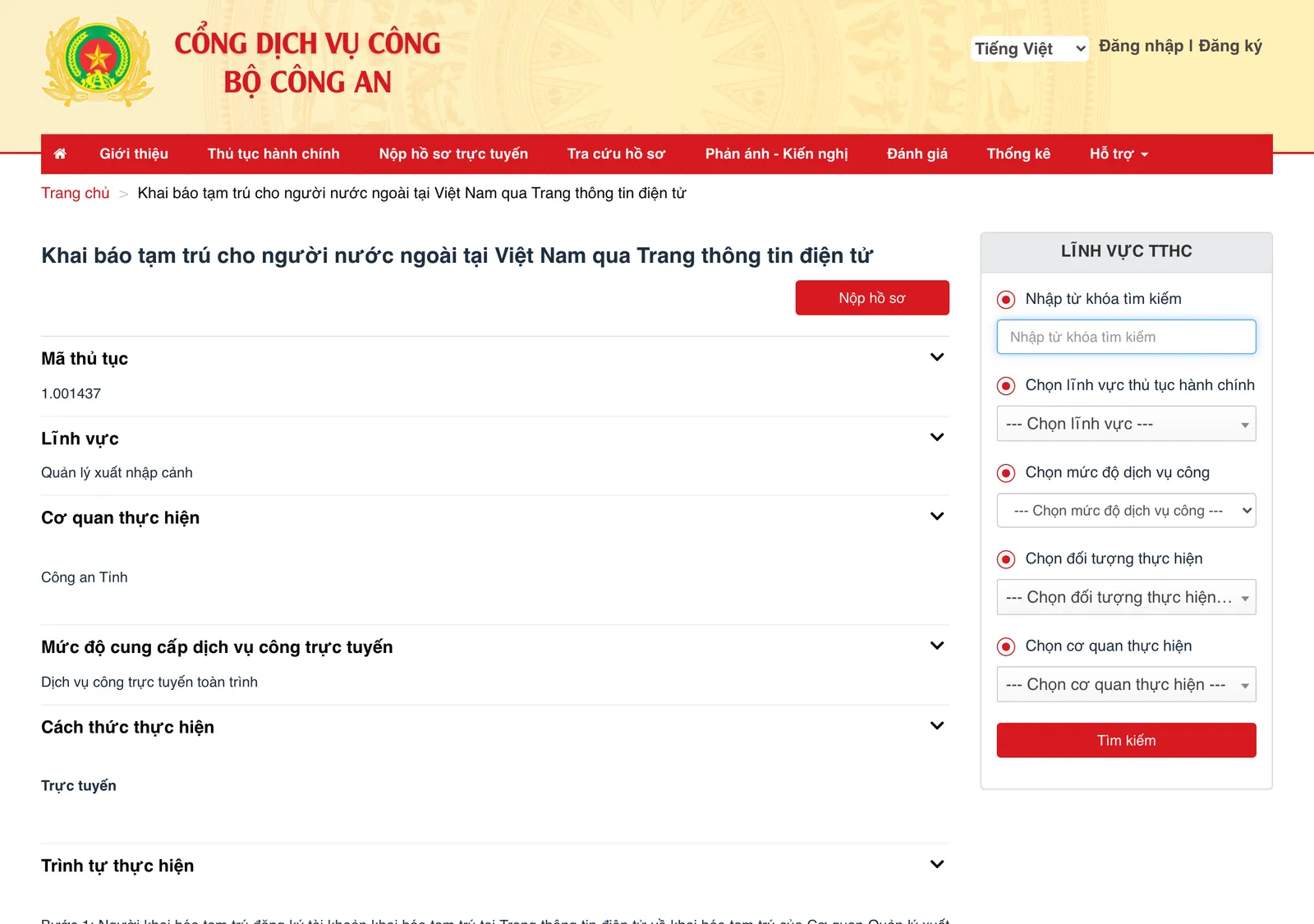
The online channel is its own listed government procedure, code 1.001437. Filed that way, the stated processing window is 24 hours a day, seven days a week, and there’s no fee for it. One thing worth flagging: the portal’s own legal-basis section still cites the old Circular 53/2016/TT-BCA, even though that circular has been replaced — a sign the page hasn’t been fully updated for the new rule below.
What proof you get
When a paper declaration is used, the police check it, ask for anything missing, confirm it, keep a copy, and hand the confirmed form straight back to whoever filed it, which is legally the accommodation, not you personally. I found no rule that gives the guest a copy of their own, so if you need a record of where you were declared, ask the accommodation that filed it.
If anything changes
If you change where you’re staying, stay somewhere other than the address on a permanent residence card, or your passport information changes, the same declaration has to be filed again, the same way.
The rule behind this, and what changed in 2026
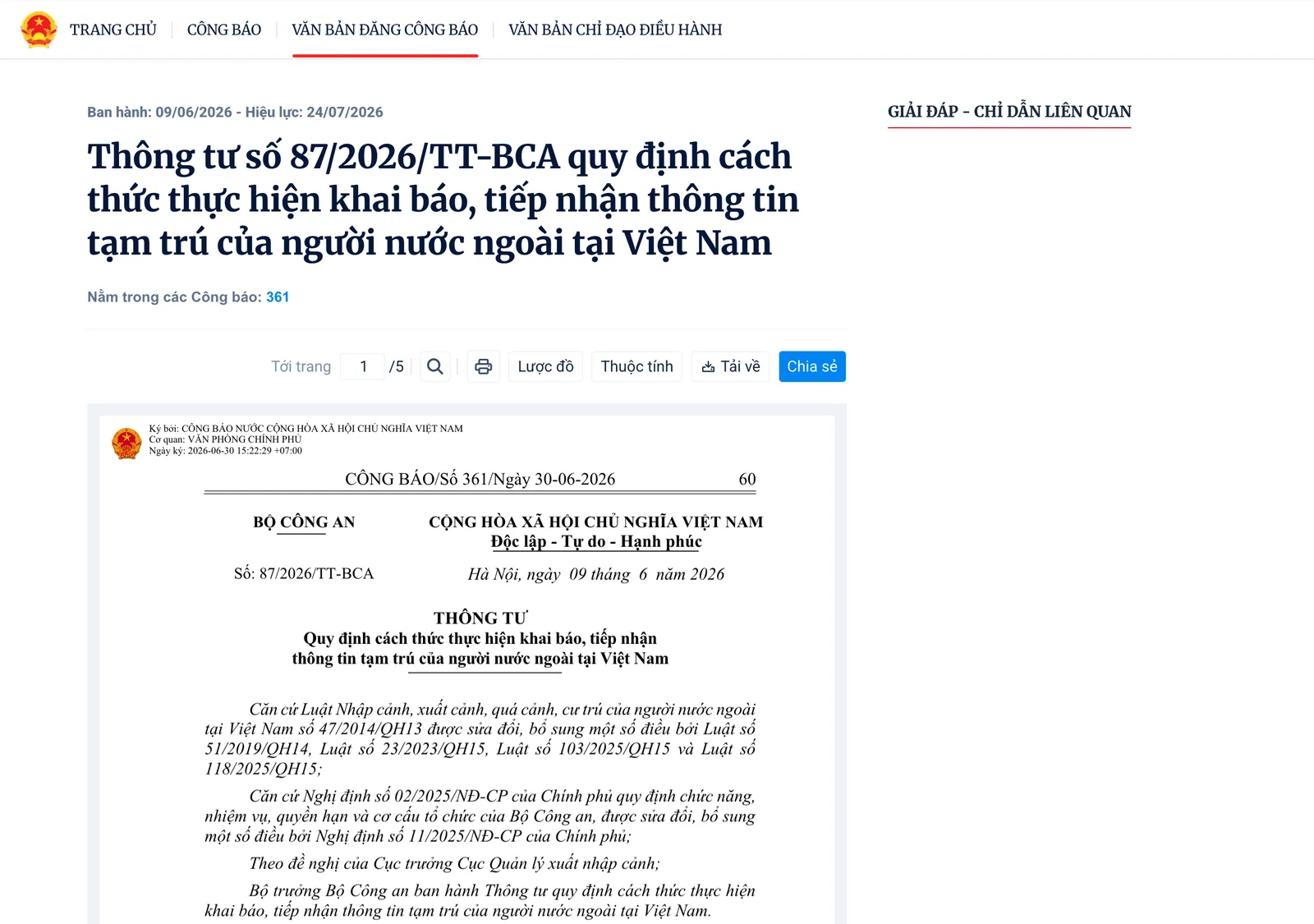
The underlying duty comes from Law 47/2014/QH13 (as amended), Article 33. The rule on how the declaration is actually carried out sits in a separate circular: Circular 87/2026/TT-BCA, in force from 24 July 2026, replaced the older Circular 53/2016/TT-BCA on the same subject.
Fines for not declaring
The accommodation is fined 3,000,000-5,000,000 VND for failing to declare 1 to 3 foreign guests, rising to 10,000,000-15,000,000 VND for 4 to 8 guests, and 15,000,000-20,000,000 VND for 9 or more. That first fine band also covers you: if you don’t hand over your passport or Vietnam-residence papers so the accommodation can complete the declaration, you’re fined under that very same clause.
How this differs from extending your stay (gia hạn tạm trú)
This declaration is not the same thing as extending your temporary stay. An extension is a separate procedure that your inviting or sponsoring organisation or individual must file with the immigration authority — there’s no route for you to file it yourself. See how to extend a visa in Da Nang for how that process works, and Vietnam immigration fees for what it costs.
How this differs from a temporary residence card
It’s also not the same as a temporary residence card (TRC). A TRC is a document issued by the immigration authority, or the competent Ministry of Foreign Affairs office, to a foreigner permitted to reside in Vietnam for a fixed period, and it’s valid in place of a visa. It is applied for through its own procedure, with a statutory processing time of 5 working days from a complete dossier. Read temporary residence card in Vietnam: how to get one in Da Nang for that procedure, or start from the Da Nang immigration office guide and the visa cluster hub for everything else in this area.
Step by step
- Hand over your passport when you arriveThe accommodation must ask for your passport (or other valid international travel document) and residence papers before it agrees to let you stay.
- Let the accommodation file the declarationIts owner, legal representative, or an authorised staff member — not you — reports your temporary residence to the local ward or commune police, either electronically or on a paper form.
- Check the deadline is metFiled online, the law requires it the moment you arrive. On paper, the accommodation has 12 hours to deliver it to police — 24 hours in remote areas.
- Ask what you'll get backOnce police confirm a paper declaration, they keep a copy and hand the confirmed form back to whoever filed it — legally the accommodation, not you personally.
- Re-declare if your situation changesA change of address, staying outside what's on a permanent residence card, or any change to your passport means the same declaration has to be filed again.
- Know the fine if it's skippedThe accommodation is fined 3,000,000-20,000,000 VND depending on how many guests go undeclared, and you're fined under the same clause if you didn't hand over your passport or papers.
Not confirmed: No government source located in this research confirms that a foreigner personally receives a copy of their own temporary-residence declaration — Circular 87/2026/TT-BCA only says the confirmed paper form goes back to whoever filed it, which is legally the accommodation. No source found describes a stand-alone fine for a foreigner who did hand over their documents but the accommodation still failed to declare them. And no source located confirms whether the most recent amending law changed the core declaration rule itself, as opposed to the other confirmed changes it made elsewhere in the statute.
Common questions
Who has to declare my temporary residence in Vietnam?
The person running your accommodation — its owner, legal representative, or an authorised staff member — not you. They report it to the ward or commune police where you're staying.
What's the deadline for the declaration?
Filed electronically, the law requires it the moment you arrive. On paper, the accommodation has 12 hours to deliver it to police — 24 hours in remote areas.
Do I need to do anything myself?
Yes — hand over your passport (or other valid international travel document) and your residence papers. The accommodation must ask for these before it agrees to let you stay.
Is there a fee for the online declaration?
No. The government's own procedure page lists no fee for it, and it's processed 24 hours a day, seven days a week.
What if I change accommodation or my passport details change?
You go through the same declaration again — for a change of address, staying outside what's on a permanent residence card, or any change to your passport.
What happens if the accommodation doesn't declare me?
It's fined 3,000,000-5,000,000 VND for 1 to 3 undeclared guests, 10,000,000-15,000,000 VND for 4 to 8, and 15,000,000-20,000,000 VND for 9 or more. You're fined under that same clause if you didn't hand over your passport or papers in the first place.
Is this the same as extending my temporary stay (gia hạn tạm trú)?
No. Extending your stay is a separate procedure your sponsor must file with the immigration authority — there's no self-filing route.
Is this the same as a temporary residence card?
No. A temporary residence card is a longer-term document issued by the immigration authority in place of a visa, applied for through its own procedure with a statutory processing time of 5 working days.
Next in Visas & residence
General information checked against the sources listed above, not legal advice for your situation. Rules and office practice change; confirm with the immigration office or a licensed adviser before you act. How these guides are checked: about Da Nang Oi.