Landlord Charging Too Much for Electricity in Vietnam? Here's the Legal Price (2026)
An electricity price cannot exceed the retail bracket the Ministry of Industry and Trade sets. With a lease of 12 months or more and registered residence, the landlord or a tenant representative signs the electricity contract directly. A landlord who charges above the regulated price is fined 20,000,000–30,000,000 VND and must refund the excess.
On this page
Say your meter reads 200 kWh this month. Under the household tariff, the first 50 kWh are priced at 1,984 VND/kWh, the next 50 at 2,050 VND/kWh and the last 100 at 2,380 VND/kWh, before VAT. A landlord’s flat rate per kWh can be checked against those prices, because the law caps the electricity price at the bracket the Ministry of Industry and Trade sets.
What the law actually caps
The retail electricity price is agreed between the seller and the buyer, but it cannot exceed the retail price bracket and tariff structure issued by the Minister of Industry and Trade. For household use, the tariff is the tiered table below. You also have a standing right, as the electricity buyer, to ask the seller to review the amount you’re billed.
The household tariff, tier by tier
On a 200 kWh reading, the first 50 kWh falls in tier 1, the next 50 kWh (51–100 kWh) falls in tier 2, and the remaining 100 kWh falls in tier 3, which covers 101–200 kWh. The household retail tariff has six tiers, before VAT:
- 0–50 kWh: 1,984 VND/kWh
- 51–100 kWh: 2,050 VND/kWh
- 101–200 kWh: 2,380 VND/kWh
- 201–300 kWh: 2,998 VND/kWh
- 301–400 kWh: 3,350 VND/kWh
- 401 kWh and up: 3,460 VND/kWh
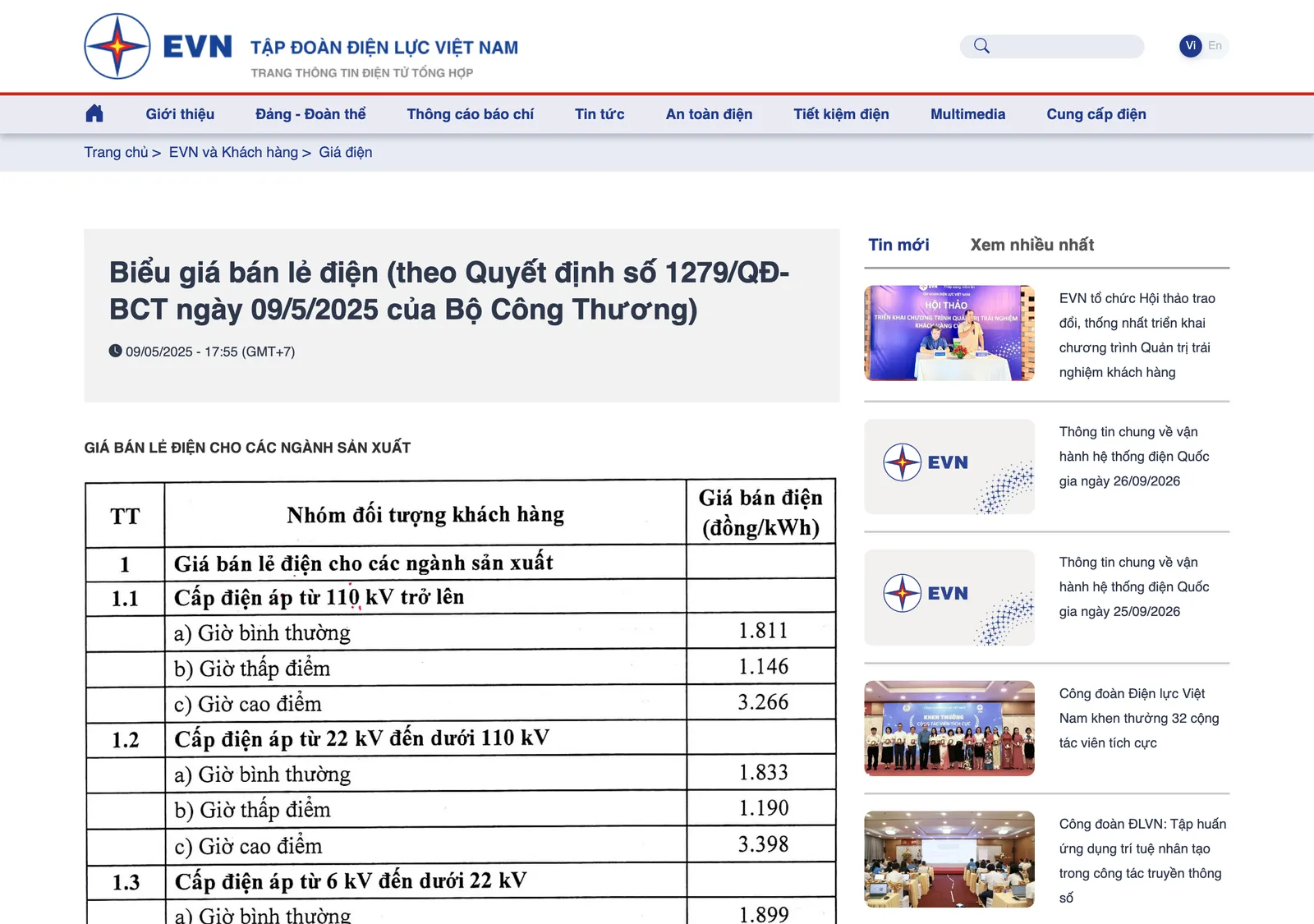
To compare, multiply each tier’s kWh by its price and add them up, then set that against what your landlord billed for the same reading.
The rule for tenants: who qualifies for the household price
At each rental address, the electricity seller signs only one electricity purchase contract, and the landlord is responsible for giving the seller residency information for the tenant living there. Where the tenant is a household (a family renting together), the landlord signs the electricity contract directly, or authorizes the tenant household to sign it with a payment commitment, and that tenant household counts as one household unit for the tariff.
Where the tenant isn’t a family unit — students and workers renting rooms, for example — the position is a transitional one. Circular 60/2025/TT-BCT replaced the previous rules on retail-tariff implementation and took effect on 2 December 2025, except for listed provisions, including the one for this situation, which take effect from the date of the next adjustment of the average retail electricity price after Decision 14/2025/QĐ-TTg takes effect. Until then, the earlier tenant rule that Circular 60/2025/TT-BCT keeps in force (Article 20) is what applies, and it works like this: with a lease of 12 months or more and registered temporary or permanent residence, the landlord (or an authorized tenant representative) signs the electricity contract directly, with the landlord committing to pay. With a lease under 12 months, if the landlord hasn’t declared the full number of occupants, the entire metered consumption for the month is billed at tier 3 (101–200 kWh), regardless of actual usage. If the landlord does declare the occupant count, every 4 people count as one household unit — 1 person is 1/4 of a unit, 2 is 1/2, 3 is 3/4, and 4 is a full unit — and the landlord must tell the seller whenever the occupant count changes.
The 12-month route requires registered temporary or permanent residence at the address. How that registration works: temporary residence registration.
If your landlord still charges more than that
A decree that took effect 25 May 2026 replaced the previous administrative-penalty rules for the electricity sector. Under it, a landlord who charges a tenant more than the regulated price, in a case where the tenant buys electricity at the household retail price for daily living, can be fined 20,000,000–30,000,000 VND. That fine level is the one that applies to an individual violator. On top of the fine, the landlord must refund the tenant the amount collected in excess, plus interest as agreed between the two of you in the rental contract.
If you want to register for your own meter, or ask directly about the household rate, Công ty Điện lực Đà Nẵng (PC Đà Nẵng)’s head office is at 35 Phan Đình Phùng, Đà Nẵng, phone (84-236) 2220.501–2220.521.
This guide sets out the rule and the prices. It is not advice on a dispute with a specific landlord.
Step by step
- Read your meter's kWh for the monthNote the kWh figure on your meter, or the reading your landlord gives you, for the billing month.
- Apply the household tiered tariff to that readingWork out which tier(s) your kWh falls into: 0–50 kWh at 1,984 VND/kWh, 51–100 kWh at 2,050 VND/kWh, 101–200 kWh at 2,380 VND/kWh, 201–300 kWh at 2,998 VND/kWh, 301–400 kWh at 3,350 VND/kWh, and 401 kWh and up at 3,460 VND/kWh, all before VAT.
- Compare that with what your landlord chargesA landlord's price for the same kWh cannot exceed the retail price bracket and tariff structure the Ministry of Industry and Trade sets.
- If you qualify, ask for the household priceWith a lease of 12 months or more and registered residence at the address, the landlord or an authorized tenant representative signs the electricity contract directly. Ask your landlord whether that has been done.
Not confirmed: A press-reported restructuring of the household tariff from six tiers to five is not yet confirmed from an official document with readable text. Whether the retail-price adjustment that would trigger it, and also switch the under-12-month tenant default away from tier 3, has already happened is unclear as of this review. Separately, one penalty decree's preamble cites a law number that other official sources attribute to an unrelated law; that looks like a drafting slip and does not change any figure here.
Common questions
Can a landlord in Vietnam charge more per kWh than EVN's household rate?
No. The retail electricity price is agreed between seller and buyer, but it cannot exceed the retail price bracket and tariff structure the Ministry of Industry and Trade issues.
What is the current household electricity tariff in Vietnam?
Six tiers, before VAT: 1,984 VND/kWh for 0–50 kWh, 2,050 VND/kWh for 51–100 kWh, 2,380 VND/kWh for 101–200 kWh, 2,998 VND/kWh for 201–300 kWh, 3,350 VND/kWh for 301–400 kWh, and 3,460 VND/kWh from 401 kWh up.
Can I insist on paying the household electricity rate as a tenant?
If your lease runs 12 months or longer and you're registered for temporary or permanent residence at the address, the landlord (or an authorized tenant representative) signs the electricity contract directly, with the landlord committing to pay.
What happens if I've rented for less than 12 months?
If the landlord hasn't declared the full number of occupants, all metered consumption is billed at the tier 3 price (101–200 kWh). If occupants are declared, every 4 people count as one household unit.
Can I ask for my electricity bill to be reviewed?
Yes. Under the Law on Electricity, the buyer has the right to ask the seller to review the amount of the electricity payment due.
Is there a penalty for a landlord who overcharges for electricity?
Yes. Where the tenant buys electricity at the household retail price, a landlord who charges more than the regulated price is fined 20,000,000–30,000,000 VND, and must refund the excess plus interest as agreed in the lease.
Who do I contact in Da Nang about registering for the household rate?
Công ty Điện lực Đà Nẵng (PC Đà Nẵng), head office at 35 Phan Đình Phùng, Đà Nẵng, phone (84-236) 2220.501–2220.521.
Next in Money & admin
General information checked against the sources listed above, not legal advice for your situation. Rules and office practice change; confirm with the immigration office or a licensed adviser before you act. See how guides are checked.
Spotted an error? Report it.