Social Insurance for Foreigners in Vietnam: Rates and Rules (2026)
A foreign employee on a fixed-term labour contract of 12 months or more with an employer in Vietnam must join compulsory social insurance and health insurance, unless one of three listed exceptions applies. Your employer deducts 8% of your contribution salary for the retirement-and-death fund, plus your one-third share of the 4.5% health-insurance contribution.
On this page
- Who must join compulsory social insurance
- What comes out of your payslip: contribution rates
- Unemployment insurance
- The salary your contributions are based on
- Getting your money back when you leave Vietnam
- Your employer’s obligations, and the penalty for not paying
- Which decree governs this today
- Common questions
If you’re a foreign employee on a fixed-term labour contract of 12 months or more with an employer in Vietnam, you’re a mandatory participant in compulsory social insurance, unless one of three listed exceptions applies. Compulsory health insurance follows the same test. Each month your employer deducts 8% of your contribution salary for the retirement-and-death fund, plus your one-third share of the 4.5% health-insurance contribution.
Who must join compulsory social insurance
A foreign employee working in Vietnam is a mandatory participant in compulsory social insurance when working under a fixed-term labour contract of 12 months or more with an employer in Vietnam, except in the cases listed below. Separately, to work in Vietnam you must hold a work permit issued by the competent Vietnamese state agency, except in the cases listed under Labor Code Article 154. This social-insurance test is separate from Vietnam’s tax residency rules, which run on different criteria.
Three exceptions apply. An intra-company transferee, as defined under the regulations on foreign workers working in Vietnam, is not a mandatory participant. Someone who has already reached retirement age under Labor Code Article 169 clause 2 at the time the labour contract is signed is not a mandatory participant. And a case covered by an international treaty that Vietnam is a party to, where that treaty provides otherwise, is not a mandatory participant.
What comes out of your payslip: contribution rates
Retirement and death fund. Each month, you pay 8% of your contribution salary into the retirement-and-death fund. Your employer pays a further 14% into the same fund.
Sickness and maternity fund. Your employer pays 3% of the contribution salary into this fund.
Occupational accident and disease insurance. A foreign employee covered by the conditions above is a mandatory participant in occupational accident and occupational disease insurance, under the Law on Occupational Safety and Hygiene and Decree 158/2025/NĐ-CP. Your employer pays a normal rate of 0.5% of the contribution salary into this fund, or 0.3% if the enterprise meets the conditions in Article 5 of the decree.
Health insurance. The same 12-month contract test that applies to social insurance also makes you a mandatory health-insurance participant, with the same intra-company-transferee, retirement-age and treaty exceptions. The monthly contribution is 4.5% of the salary used as the basis for compulsory social insurance: your employer pays two-thirds and you pay one-third.
Unemployment insurance
The Employment Law requires “workers” (người lao động) to join unemployment insurance. Under this law, a “worker” is defined as a Vietnamese citizen aged 15 or over who is able to work and needs work.
The salary your contributions are based on
The salary used as the basis for compulsory social-insurance contributions is at least the reference level and at most 20 times the reference level at the time of payment. The reference level is an amount of money decided by the Government, used to calculate contribution and benefit levels for a number of social-insurance schemes under the Law on Social Insurance. For as long as the base salary (mức lương cơ sở) has not been abolished, the reference level equals the base salary — currently VND 2,530,000 a month, effective from 1 July 2026.
Getting your money back when you leave Vietnam
If you stop participating in social insurance and apply, you’re entitled to a one-time social-insurance payment in one of the following cases:
- Your labour contract ends, or your work permit, practising certificate or practising licence expires without being renewed.
- You’re eligible for a pension under the regulations but do not continue residing in Vietnam.
- You’ve reached retirement age but have fewer than 15 years of social-insurance contributions.
- You have one of the listed serious illnesses — cancer, paralysis, decompensated cirrhosis, severe tuberculosis, or AIDS.
- Your work-capacity reduction is 81% or more, or you’re a person with an especially severe disability.
Your employer’s obligations, and the penalty for not paying
Your employer must register your compulsory social-insurance participation and pay compulsory social insurance on your behalf, deducting your own share from your wages to pay into the fund at the same time.
An employer that late-pays compulsory social insurance is fined 12% to 15% of the total amount paid late at the time the violation record is made, up to VND 75,000,000. An employer that evades compulsory social insurance entirely is fined 18% to 20% of the total amount evaded, up to VND 75,000,000. These are the fines for an individual; the fine for an organisation is 2 times the fine for an individual.
Which decree governs this today
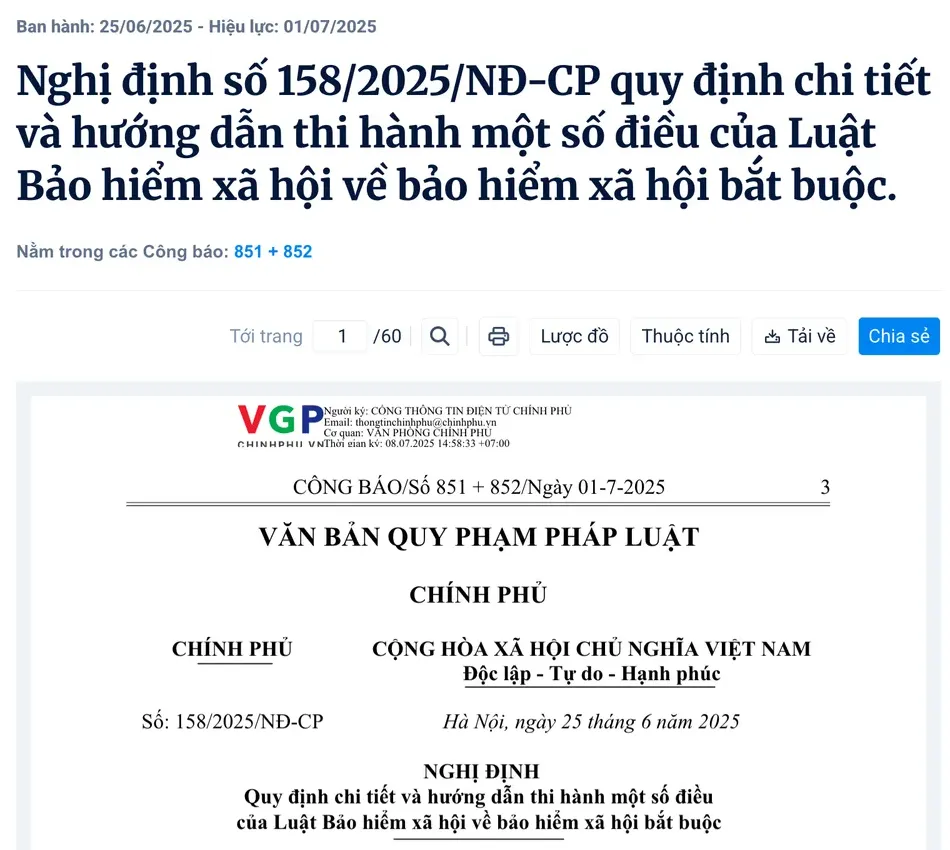
Decree 158/2025/NĐ-CP fully replaces the decree that used to specifically govern compulsory social insurance for foreign employees. It also fully replaces an earlier decree that had detailed a number of articles of the Law on Social Insurance on compulsory social insurance.
Thinking of buying a home here? See buying an apartment in Da Nang as a foreigner. For more on managing money in Vietnam, see the money guide.
Not confirmed: Whether the 0.3% reduced occupational-accident/disease rate (conditions in Article 5 of Decree 58/2020/NĐ-CP, as amended) is what most employers of foreign staff actually pay, or whether 0.5% remains the standard rate — this guide presents 0.5% as the standard. Decree 188/2025/NĐ-CP is commonly described as replacing the previous decree governing the health-insurance contribution rate, but this was not confirmed from the decree's own primary signed text, including its own issued and effective dates.
Common questions
Do I also need a work permit?
To work in Vietnam, a foreign employee must hold a work permit issued by the competent Vietnamese state agency, except in the cases listed in Labor Code Article 154. The social-insurance test itself is the labour contract of 12 months or more.
What happens if my employer doesn't pay my social insurance?
An employer that late-pays compulsory social insurance is fined 12% to 15% of the amount paid late, up to VND 75,000,000. One that evades payment entirely is fined 18% to 20% of the amount evaded, up to VND 75,000,000. These are the fines for an individual; the fine for an organisation is 2 times the fine for an individual.
Do foreign employees pay into unemployment insurance?
The Employment Law requires 'workers' (người lao động) to join unemployment insurance. Under this law, a 'worker' is defined as a Vietnamese citizen aged 15 or over who is able to work and needs work.
Can I get my social insurance money back when I leave Vietnam?
You're entitled to a one-time social-insurance payment when your labour contract ends, or your work permit, practising certificate or practising licence expires without being renewed, or if you're eligible for a pension but do not continue residing in Vietnam.
Is there a maximum salary that social insurance is calculated on?
The salary used as the contribution base is at least the reference level and at most 20 times the reference level at the time of payment. The reference level currently equals the base salary, VND 2,530,000 a month.
Are intra-company transferees exempt from compulsory social insurance?
A foreign employee moved within the same enterprise under the regulations on foreign workers in Vietnam — an intra-company transferee — is not a mandatory participant.
What decree currently governs compulsory social insurance for foreign employees?
Decree 158/2025/NĐ-CP fully replaces the decree that used to specifically govern compulsory social insurance for foreign employees.
Next in Money & admin
- Can Foreigners Buy an Apartment in Da Nang? (2026 Rules)Verified
- Landlord Charging Too Much for Electricity in Vietnam? Here's the Legal Price (2026)Verified
- How to Open a Bank Account in Vietnam as a Foreigner (2026)Verified
- Driving in Vietnam as a Foreigner: Licence, IDP and Conversion RulesVerified
General information checked against the sources listed above, not legal advice for your situation. Rules and office practice change; confirm with the immigration office or a licensed adviser before you act. See how guides are checked.
Spotted an error? Report it.