Work Permit Vietnam for Foreigners: Who Needs One and Who's Exempt (2026)
Foreign workers in Vietnam need a work permit unless an exemption in the Labor Code or Decree 219/2025/NĐ-CP applies — most exemptions still need a confirmation certificate, some just advance notice. Your employer files at the Public Administrative Service Center 10 to 60 days before you start; the agency then decides within 10 working days.
On this page
- Who’s exempt from a Vietnam work permit
- Getting a confirmation of exemption certificate
- Exemptions that need a notice instead
- What the employer files for a work permit
- Which Da Nang agency decides your case
- Validity and renewal
- The decree in force today
- What happens if you work without a permit
- After the work permit: your visa and residency
- Step by step
- Common questions
Start with two questions. Does your situation match one of the exemption categories Vietnam’s Labor Code or Decree 219/2025/NĐ-CP sets out? And if it does, does that category still call for a confirmation of exemption certificate, or only advance notice from your employer? If no exemption applies, you need a work permit issued by the Vietnamese authorities to work in Vietnam.
Who’s exempt from a Vietnam work permit
Vietnam’s Labor Code exempts a handful of standing categories from needing a work permit at all.
- An LLC owner or capital-contributing member with at least VND 3 billion (3 tỷ đồng) of capital in the company.
- A joint-stock company’s board chairman or board member, at the same VND 3 billion threshold.
- The head of a representative office or project — or the person mainly responsible for its activities — of an international organisation or foreign NGO in Vietnam.
- Someone entering Vietnam for under 3 months to pitch a service.
- Someone entering Vietnam for under 3 months to fix a complex technical or technology incident that no expert already in the country can resolve.
- A foreign lawyer licensed to practise in Vietnam under the Law on Lawyers.
- A case covered by an international treaty Vietnam has joined.
- A foreigner married to a Vietnamese citizen and living in Vietnam.
The Labor Code leaves room for the Government to add more cases, and Decree 219/2025/NĐ-CP — in force since 7 August 2025 — does, including:
- An ODA-funded consulting or research assignment.
- A confirmed foreign journalist on a press assignment.
- A teacher or manager sent to run an education institution set up by a foreign diplomatic mission or intergovernmental organisation.
- A foreign student or trainee with an internship agreement or job offer letter, or an apprentice on a Vietnamese-flagged ship.
- A family member of foreign-mission staff, permitted to work under a treaty.
- Someone holding an official passport and working for a state or political organisation.
- The person responsible for setting up a company’s commercial presence in Vietnam.
- An unpaid treaty volunteer confirmed by a foreign mission or international organisation in Vietnam.
- Someone carrying out an international agreement signed by a Vietnamese central or provincial agency.
- A manager, executive, expert or technical worker in Vietnam for under 90 days total in one calendar year.
- An intra-corporate transferee moved within a foreign company with a commercial presence in one of Vietnam’s 11 WTO-committed service sectors, employed by that company for at least 12 months beforehand.
- Someone confirmed by the Ministry of Education and Training to teach, research or transfer an international curriculum, or to manage a school set up by a foreign diplomatic mission or intergovernmental organisation.
- Someone confirmed by a ministry or provincial government to work in a priority field such as finance, science, technology or national digital transformation.
If none of that matches your situation, you need a work permit.
Getting a confirmation of exemption certificate
Falling into an exempt category doesn’t mean the paperwork disappears entirely. A specific carve-out of categories can skip straight to a notice — everyone else in an exempt category still has to apply for a confirmation of exemption certificate before starting work. Your employer files the request at the Public Administrative Service Center where you’ll be working, at least 10 but no more than 60 days before your start date. The agency then has 5 working days to issue the certificate, or refuse it in writing with its reasons. The certificate is valid for as long as a matching work permit would run, capped at 2 years.
Exemptions that need a notice instead
A smaller group skips the certificate and gives advance notice instead. This covers being married to a Vietnamese citizen, a licensed foreign lawyer, entering for under 3 months to pitch a service or fix a technical incident, an LLC owner or board member at or above the VND 3 billion threshold, a confirmed foreign journalist, a family member of foreign-mission staff, someone setting up a commercial presence, and anyone working under 90 days total in a calendar year. For these, your employer only has to notify the competent agency at least 3 working days before you start work. Miss that notice, or send it late or incomplete, and the employer is fined 1,000,000 to 3,000,000 VND, or double that if it is a company.
What the employer files for a work permit
If you don’t qualify for any exemption, the dossier centres on your employer’s own written report — explaining why it needs a foreign worker, and requesting the permit, on the decree’s official form. It also needs a judicial record, or a certification that you’re not serving a criminal sentence, don’t have an unspent conviction, and aren’t under criminal investigation, issued no more than 6 months before filing. Your employer files the complete dossier at the Public Administrative Service Center, at least 10 but no more than 60 days before you start work. From there, the competent agency has 10 working days to approve and issue the permit.

Which Da Nang agency decides your case
Provincial-level People’s Committees hold the authority to grant, re-grant, renew and revoke both work permits and confirmation certificates, for wherever the foreign worker is expected to work, and each one can delegate that authority to another agency of its choosing. Da Nang has done exactly that: a city decision effective 7 November 2025 delegates that authority to the Department of Home Affairs (Sở Nội vụ). That doesn’t change where the file goes in: your employer submits the dossier at the Public Administrative Service Center, and Sở Nội vụ is the agency that decides.
Tầng 9, 10, 19 Trung tâm Hành chính thành phố, số 24 Trần Phú, phường Hải Châu, Đà Nẵng · Open in Google Maps
Validity and renewal
A work permit runs for however long the underlying document does — your intended labor contract, a secondment letter, or a service contract — capped at 2 years either way. To renew, your employer files at the Public Administrative Service Center at least 10 but no more than 45 days before the permit expires. The competent agency then has 10 working days to approve the renewal, or must reply in writing with its reasons if it won’t. A permit can only be renewed once, for a maximum additional 2 years.
The decree in force today
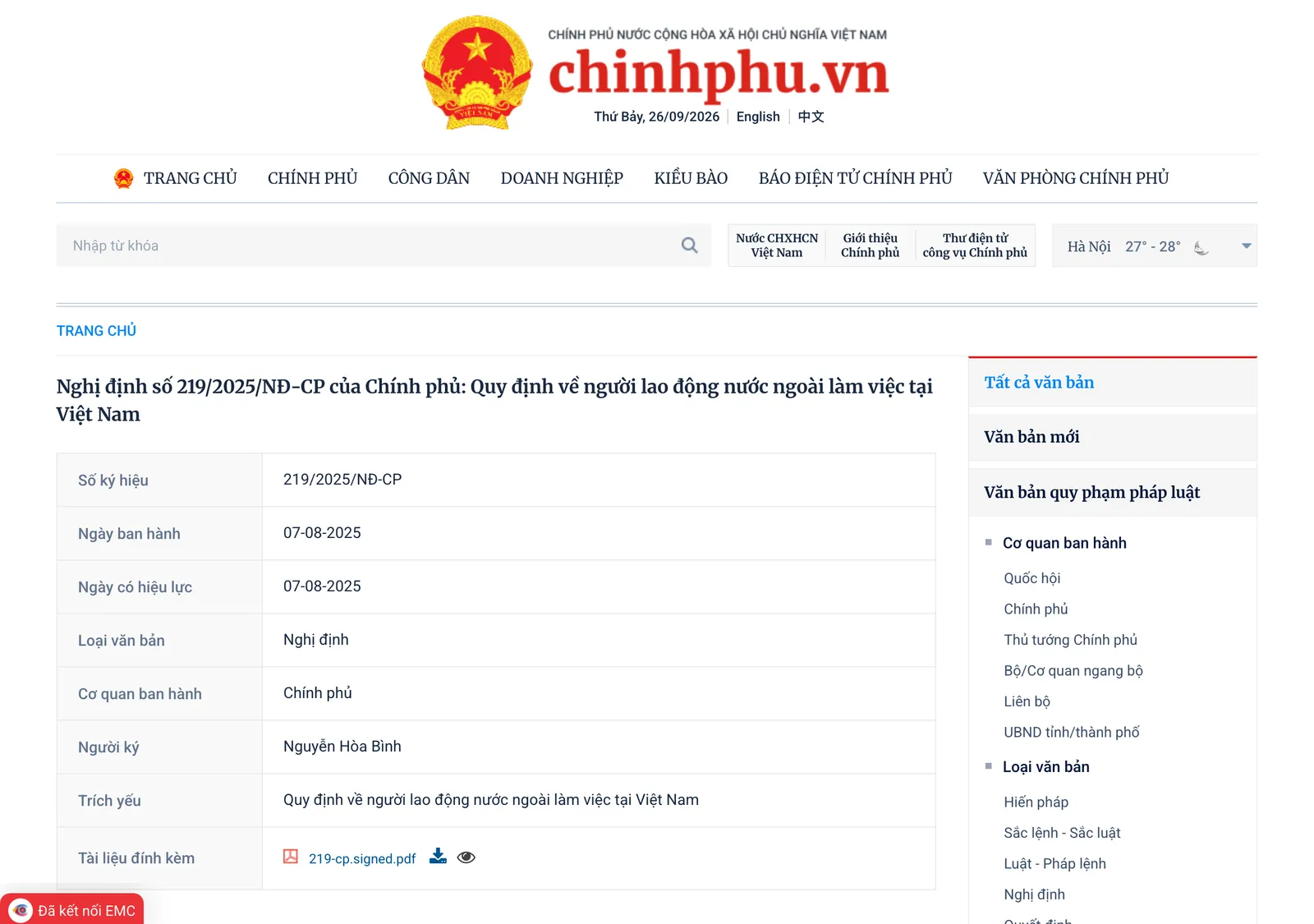
This entire framework runs on Decree 219/2025/NĐ-CP, in force since 7 August 2025. It fully replaces the old Decree 152/2020/NĐ-CP, as amended by Decree 70/2023/NĐ-CP, both of which stopped applying the same day. Fines for breaking the rules sit in a separate instrument: Decree 283/2026/NĐ-CP, in force since 10 September 2026, which replaces the fine schedule under the older Decree 12/2022/NĐ-CP.
What happens if you work without a permit
The fines fall on both sides. A foreign worker who works without a permit or exemption certificate — or keeps using one that has expired — is fined 15,000,000 to 25,000,000 VND. An employer that alters or falsifies dossier documents, or uses forged ones, is fined 40,000,000 to 60,000,000 VND. Deportation of the foreign worker is an additional penalty tied to those two violations specifically, not to the headcount-scaled one below. Employing foreign workers without the right paperwork also carries its own scale by headcount: 30,000,000 to 45,000,000 VND for 1 to 10 workers, 45,000,000 to 60,000,000 VND for 11 to 20, and 60,000,000 to 75,000,000 VND for 21 or more. All of those figures are the individual rate — a company or other organisation employer is fined double.
After the work permit: your visa and residency
Holders of LĐ1 and LĐ2 visas, the work visa symbols, are on the law’s list of people who can be issued a temporary residence card — see temporary residence card in Vietnam for how long each visa tier lasts and what that application needs. For the wider 2026 fee schedule across visas, TRCs and extensions, see Vietnam immigration fees in 2026.
Step by step
- Check whether you're exemptCompare your situation against the exemptions in Vietnam's Labor Code and Decree 219/2025/NĐ-CP — some categories need nothing but advance notice.
- File for a confirmation of exemption, if it appliesYour employer files at the Public Administrative Service Center 10 to 60 days before you start; the agency answers within 5 working days.
- If you're not exempt, build the work permit dossierThe core documents are your employer's written report and request on the official form, plus a judicial record no older than 6 months.
- Have your employer file the dossierIt goes to the Public Administrative Service Center where you'll work, 10 to 60 days before your start date; in Da Nang, the Department of Home Affairs (Sở Nội vụ) holds the authority to issue the permit.
- Wait for the decisionThe competent agency has 10 working days to approve and issue the permit.
- Renew before it expiresFile at the Public Administrative Service Center 10 to 45 days before expiry; a permit can only be renewed once, for up to 2 more years.
Not confirmed: Da Nang's exact 2026 government fee for issuing, re-issuing or renewing a work permit is not confirmed by any primary source found for this article; secondary sources give conflicting figures. Whether Decree 219/2025/NĐ-CP loosened the experience thresholds for an 'expert' or 'technical worker' compared with the older Decree 152/2020/NĐ-CP is not confirmed here either — this article does not compare the two decrees' wording line by line. And no source found states whether Da Nang's 2025 city delegation decision to Sở Nội vụ covers filings from the part of the merged city that used to be Quảng Nam province.
Common questions
Do I need a work permit to work in Vietnam?
Yes, unless you fall under one of the exemptions in Vietnam's Labor Code or Decree 219/2025/NĐ-CP.
Who is exempt from needing a Vietnam work permit?
Company owners and board members with at least 3 tỷ đồng (VND 3 billion) of capital, representative-office heads of international organisations, licensed foreign lawyers, treaty cases, and people married to a Vietnamese citizen and living in Vietnam — plus further specific categories the decree adds, from ODA-funded consultants to intra-corporate transferees.
Does every exempt category skip the paperwork?
No — only a specific carve-out, including licensed lawyers, marriage-based cases, and LLC owners or board members above the threshold, needs just advance notice, at least 3 working days before starting work.
Who files the work permit application — me or my employer?
Your employer files it, at the Public Administrative Service Center where you'll be working, at least 10 but no more than 60 days before your start date.
How long does a Vietnam work permit last, and can it be renewed?
Up to 2 years, matching your labor contract or secondment letter, and it can be renewed once, for a further 2 years.
What happens if I work in Vietnam without a permit?
You're fined 15,000,000 to 25,000,000 VND, and your employer is fined from 30,000,000 up to 75,000,000 VND depending on how many workers are affected — doubled if the employer is a company.
How much does a Vietnam work permit cost in Da Nang?
I did not find the 2026 Da Nang fee in a primary source, and secondary sources disagree, so ask the Public Administrative Service Center when your employer files.
Which Da Nang agency decides on work permits?
The Department of Home Affairs (Sở Nội vụ), under a 2025 city delegation decision — though your employer files the dossier at the Public Administrative Service Center, not at the department.
Next in Visas & residence
General information checked against the sources listed above, not legal advice for your situation. Rules and office practice change; confirm with the immigration office or a licensed adviser before you act. How these guides are checked: about Da Nang Oi.