Can Foreigners Get Health Insurance (BHYT) in Vietnam?
A foreign employee on a Vietnamese labour contract of 12 months or more is a participant in BHYT, Vietnam's compulsory state health insurance. The contribution is 4.5% of the salary used for social insurance, split two-thirds employer and one-third employee. Whether a foreigner not employed here can join as a household member is unresolved: no official source found says.
On this page
Người lao động là công dân nước ngoài làm việc tại Việt Nam khi làm việc theo hợp đồng lao động xác định thời hạn có thời hạn từ đủ 12 tháng trở lên với người sử dụng lao động tại Việt Nam, trừ trường hợp là người di chuyển trong nội bộ doanh nghiệp theo quy định của pháp luật về người lao động nước ngoài làm việc tại Việt Nam hoặc tại thời điểm giao kết hợp đồng lao động đã đủ tuổi nghỉ hưu theo quy định tại khoản 2 Điều 169 của Bộ luật Lao động hoặc điều ước quốc tế mà nước Cộng hòa xã hội chủ nghĩa Việt Nam là thành viên có quy định khác.
A foreign employee working in Vietnam under a fixed-term labour contract of 12 months or more with an employer in Vietnam — except an intra-company transferee, someone already at retirement age when the contract was signed, or a case an international treaty provides otherwise for. Law on Health Insurance, Điều 12 khoản 1 điểm c, as amended by Luật 51/2024/QH15
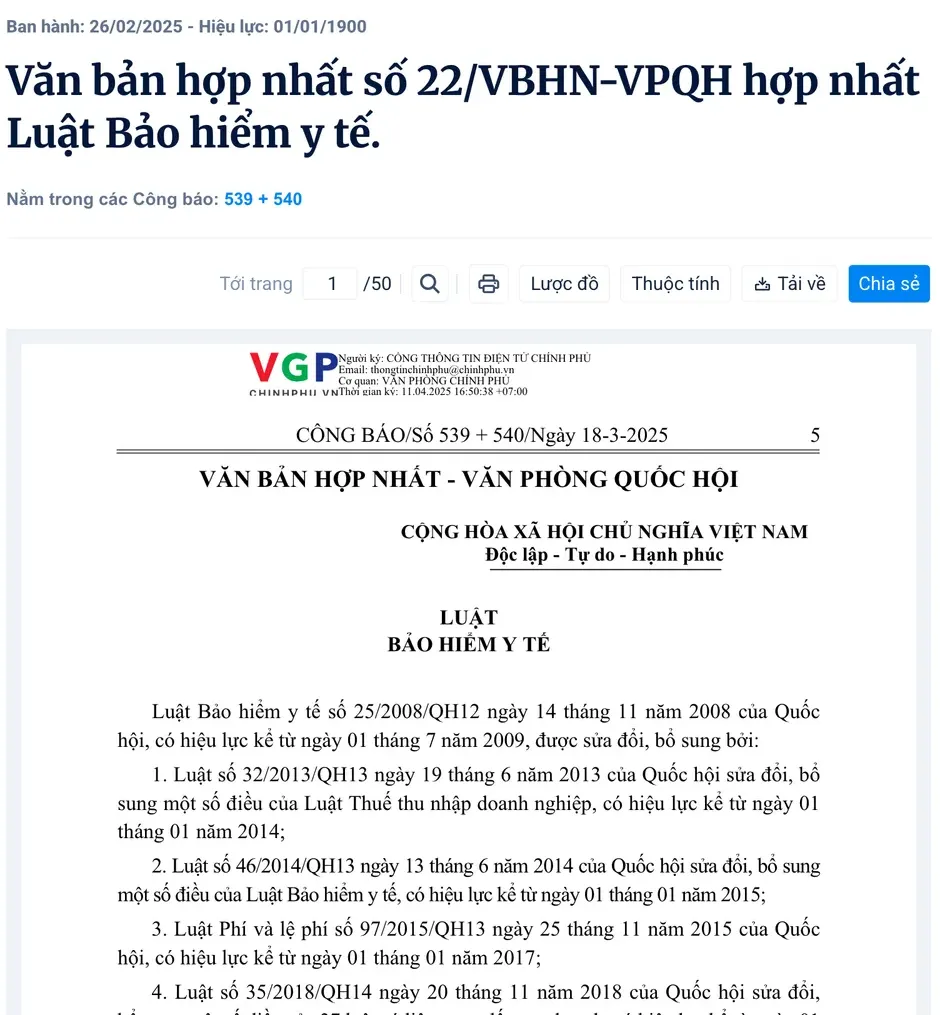
Foreign employees must join
The group whose health insurance is paid by the employer, the employee, or jointly, includes a foreign employee working in Vietnam under a fixed-term labour contract of 12 months or more with an employer in Vietnam — except an intra-company transferee, someone who had already reached retirement age when the contract was signed, or a case an international treaty Vietnam is a party to provides otherwise for.
See the social insurance for foreigners article for the employment side of this — visas, work permits and the labour contract test.
Contribution rate
For a foreign employee in this group, the monthly contribution — paid by the employer, the employee, or jointly — is 4.5% of the monthly salary used as the basis for compulsory social-insurance contributions, of which the employer pays two-thirds and the employee pays one-third.

Foreigners not employed here: an open question
Vietnam’s health-insurance law also has a self-paying group (nhóm tự đóng), made up of four categories: household members, people living and working, or being raised or cared for, in a charitable or religious organisation or institution, an employee during a period of unpaid leave or with a suspended labour contract, and a person not falling into the other three categories of this clause.
For the household category, the law defines “a household participating in health insurance” as people who jointly register permanent residence, or jointly register temporary residence, at the same lawful place of residence, as provided by the law on residence. Vietnam’s Law on Residence states its own scope as the exercise of the right to freedom of residence of Vietnamese citizens on the territory of the Socialist Republic of Vietnam, and the registration and management of residence — a foreigner’s stay is registered instead under the separate law on the entry, exit, transit and residence of foreigners. No document or government source found for this article states whether a foreigner’s residence registration under that separate law counts as registration “under the law on residence” for the household definition above. See “Not confirmed” below for the full open question.
If a person is counted as a household member for BHYT, the monthly household contribution is 4.5% of the base salary for the first member, with the second, third and fourth members paying 70%, 60% and 50% of the first member’s contribution, and each member from the fifth onward paying 40%.
Foreign students on a Vietnamese government scholarship
A foreigner currently studying in Vietnam who has been awarded a scholarship from the Vietnamese State budget belongs to the state-budget-paid group. The monthly contribution for this group is 4.5% of the base salary, paid through the agency, organisation or unit that awarded the scholarship.
What BHYT covers: the benefit level
At your registered facility
| Case | Benefit level |
|---|---|
| Groups a, b, c, d, đ, e, h, i, o, r and s of Điều 12 khoản 3 | 100% |
| Treatment at a facility belonging to the first-contact tier | 100% |
| A single visit costing less than the level the Government sets | 100% |
| 5 years’ continuous participation, with the year’s co-payments over 6 times the reference level | 100% |
| Groups at Điều 12 khoản 2 điểm a; khoản 3 điểm k; khoản 4 điểm a and điểm g | 95% |
| Any other subject | 80% |
The facilities that count as first-contact tier are: commune health stations; family-medicine practices; military-civilian medical stations and clinics; district-level medical centres whose examination and treatment activity is licensed to operate as a clinic; medical units of agencies, units or organisations as the Minister of Health prescribes; and first-contact-tier facilities within the army or police as the Minister of National Defence or the Minister of Public Security prescribes.
Going to a facility other than your registered one
Going, on your own initiative, to a facility other than your registered first-contact facility, and not in accordance with the patient-transfer rules of Articles 26 and 27 — except for the cases in clauses 3 and 5 of this article — is paid by the health-insurance fund at a percentage of the benefit level set out in clause 1 above, as follows:
| Situation | Benefit level |
|---|---|
| Confirmed diagnosis or treatment of a rare disease, a life-threatening disease, or a disease needing surgery or a high-level technique, at a basic- or advanced-tier facility | 100% |
| Ethnic-minority or poor-household person in a difficult area, or a resident of an island commune or district, inpatient at an advanced-tier facility | 100% |
| Treatment at a first-contact tier facility | 100% |
| Inpatient treatment at a basic-tier facility | 100% |
| Basic- or advanced-tier facility that was determined district-level before 1 January 2025 | 100% |
| Outpatient at a basic-tier facility, per the Government’s roadmap (except the rare-disease and former district-level cases above) | 50–100% |
| Inpatient at an advanced-tier facility (except the rare-disease, ethnic-minority/island, former district-level and former provincial-level cases) | 40% |
| Advanced-tier facility that was determined provincial-level before 1 January 2025 — outpatient / inpatient | 50% / 100% |
Registering and changing your first-contact facility
A BHYT participant has the right to register their first-contact health-insurance facility at a first-contact-tier or basic-tier facility, and has the right to change their registered first-contact facility within the first 15 days of each quarter.
BHYT versus private health insurance
Vietnam’s Law on Health Insurance defines BHYT itself as a compulsory form of insurance applied to the subjects specified in the Law, for healthcare, not for profit, organised and implemented by the State. That is the extent of what the legal text itself says about what BHYT is — it does not otherwise compare BHYT with a private policy.
Not confirmed: Whether a foreigner living in Vietnam who is not employed here, not a scholarship student, and not otherwise named in Điều 12 — a tourist on a long-stay visa, a retiree, a remote worker, or the spouse of a citizen — can join BHYT through the household or self-paying group is not stated by a document or gov source found. The law's own definition of a household requires people who jointly register permanent or temporary residence "as provided by the law on residence". Vietnam's Law on Residence states its own scope as the residence registration of Vietnamese citizens; a foreigner's stay is registered under a separate law on the entry, exit, transit and residence of foreigners instead. No source found confirms or rules out whether that separate registration counts for the household definition. Separately, whether the Law on Health Insurance's definition of "bảo hiểm y tế" (Điều 2 khoản 1) is still in its original wording, or was amended by a later law, could not be confirmed against a primary Official Gazette copy.
Common questions
Do foreign employees have to join Vietnam's state health insurance (BHYT)?
A foreign employee working in Vietnam under a fixed-term labour contract of 12 months or more with an employer here must join BHYT, except an intra-company transferee, someone already at retirement age when the contract was signed, or a case an international treaty provides otherwise for.
Can a foreigner who isn't working in Vietnam join BHYT through the household route?
No official source found for this guide settles it: the household definition requires joint residence registration under the law on residence, and Vietnam's Law on Residence states its scope as the residence registration of Vietnamese citizens — no source says whether a foreigner's residence registration counts.
Who pays the BHYT contribution for a foreign employee?
The monthly contribution is 4.5% of the salary used as the basis for compulsory social-insurance contributions, with the employer paying two-thirds and the employee paying one-third.
What percentage of medical costs does BHYT cover?
At a first-contact tier facility, BHYT pays 100% of costs; for a subject not in one of the higher-percentage groups, it pays 80%.
What happens if I go to a hospital other than my registered first-contact facility?
Going on your own initiative to a facility other than your registered first-contact facility, outside the referral rules in Articles 26 and 27, is paid at a percentage of the clause-1 benefit level, and that percentage depends on the facility tier and the case — the table in the article lists each one.
Can I change my registered first-contact health facility?
A BHYT participant can change their registered first-contact facility within the first 15 days of each quarter.
Do foreign students on Vietnamese government scholarships get BHYT?
A foreigner studying in Vietnam on a scholarship funded by the Vietnamese State budget belongs to the state-budget-paid BHYT group, with a monthly contribution of 4.5% of the base salary paid through the agency that awarded the scholarship.
What's the difference between BHYT and private health insurance?
The law itself only defines BHYT as a compulsory insurance applied to the subjects the Law specifies, for healthcare, not for profit, organised by the State — it does not otherwise compare BHYT with private insurance.
Next in Healthcare
General information checked against the sources listed above, not legal advice for your situation. Rules and office practice change; confirm with the immigration office or a licensed adviser before you act. See how guides are checked.
Spotted an error? Report it.