Vietnam Income Tax for Remote Workers Paid Abroad (2026)
A resident is taxed on wages arising inside and outside Vietnam at 5% to 35%. A non-resident pays 20% on wages for work performed in Vietnam. A resident paid from abroad declares directly with the tax authority every quarter, then usually finalises for the year. Law 109/2025/QH15 applies to a resident's wages from the 2026 tax period.
On this page
You live in Da Nang and a company or clients abroad pay you. The Personal Income Tax Law says whose income Vietnam taxes.
Người nộp thuế thu nhập cá nhân là cá nhân cư trú có thu nhập chịu thuế … phát sinh trong và ngoài lãnh thổ Việt Nam và cá nhân không cư trú có thu nhập chịu thuế … phát sinh trong lãnh thổ Việt Nam.
A resident individual is taxed on taxable income arising inside and outside Vietnam; a non-resident individual is taxed on taxable income arising within Vietnam.
Law 109/2025/QH15, Điều 2 khoản 1
Law 109/2025/QH15 took effect on 1 July 2026, and its rules on a resident’s wages apply from the 2026 tax period. Law 04/2007/QH12 is replaced by the new Law: it ceased to be effective when the new Law took effect, and its resident-wage rules ceased from the 2026 tax period.
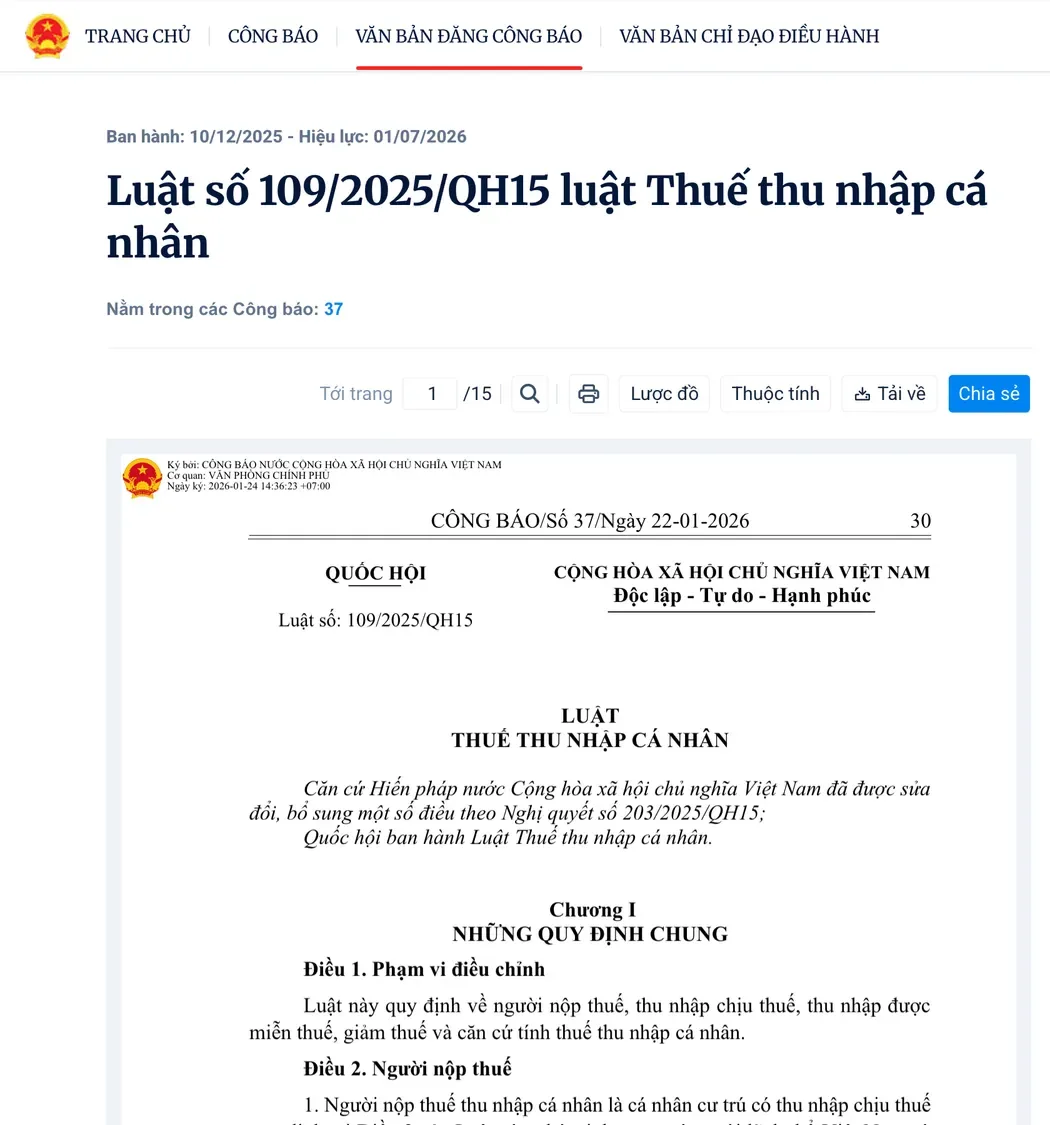
This page summarises the legal text. It is not tax advice and does not cover a freelancer with a registered business.
Which rules apply to you
If you are a resident
A resident individual meets one of the listed conditions. One is being present in Vietnam 183 days or more in a calendar year, or in 12 consecutive months from the first day of presence.
Another is a regular residence in Vietnam, which includes a registered permanent residence or a rented home under a fixed-term lease. For a resident, taxable income arises inside and outside Vietnam, regardless of where it is paid and received.
For the day count, read the Vietnam tax residency explainer.
If you are a non-resident
A non-resident individual is a person who does not meet the condition in clause 2 of the same article. For a non-resident, taxable income is income arising within Vietnam, regardless of where it is paid and received.
What counts as wages
Wages include amounts an employee receives from an employer in any form, in cash or in kind.
Fees an individual receives for services also count, when the individual has no business registration and no tax registration for a business activity, with or without a practising licence.
Resident: tax rates on salary
Tax is the taxable income, wherever the income is paid, multiplied by the rates in the partial progressive schedule. Taxable income is the total taxable wage income received in the tax period. From it, insurance contributions and the deductions in Articles 10 and 11 of the Law are subtracted.
Partial progressive schedule for wages (Law 109/2025/QH15, Article 9):
| Bracket | Per year (VND million) | Per month (VND million) | Rate |
|---|---|---|---|
| 1 | Up to 120 | Up to 10 | 5% |
| 2 | Over 120 to 360 | Over 10 to 30 | 10% |
| 3 | Over 360 to 720 | Over 30 to 60 | 20% |
| 4 | Over 720 to 1,200 | Over 60 to 100 | 30% |
| 5 | Over 1,200 | Over 100 | 35% |
Tax is calculated bracket by bracket: the part of income in each bracket is multiplied by that bracket’s rate.
Family deductions
Family deductions are subtracted from taxable income before tax is computed on a resident’s wages. The deduction is VND 15.5 million a month (VND 186 million a year) for you and VND 6.2 million a month for each dependant.
The Law’s rules on a resident’s wages, which include these deductions, apply from the 2026 tax period. The Government submits deduction amounts to the National Assembly Standing Committee to fit each period’s conditions, so check the amount for your tax period.
Non-resident: 20% on wages for work done in Vietnam
Tax on a non-resident’s wages is the total wages received for work performed in Vietnam, multiplied by 20%, regardless of where the income is paid.
Thuế thu nhập cá nhân đối với thu nhập từ tiền lương, tiền công của cá nhân không cư trú được xác định bằng tổng số tiền lương, tiền công mà cá nhân không cư trú nhận được do thực hiện công việc tại Việt Nam nhân (x) với thuế suất 20%, không phân biệt nơi trả thu nhập.
Tax on a non-resident’s wages is the total wages received for work performed in Vietnam, multiplied by 20%, regardless of where the income is paid.
Law 109/2025/QH15, Điều 21
Decree 253/2026/NĐ-CP restates the same rule. For a non-resident, the tax period is each occurrence of income.
Working in Vietnam and abroad at the same time
A non-resident who works in Vietnam and abroad at the same time, with an income part in Vietnam that cannot be separated, uses a formula set in the decree.
For a foreign individual present in Vietnam in that case, income arising in Vietnam is days present in Vietnam divided by 365, multiplied by global pre-tax wage income. Other pre-tax taxable income arising in Vietnam is added. The other taxable income is benefits in cash or in kind, beyond wages, that the employer pays or pays on the employee’s behalf.
Who withholds tax and who declares
Organisations and individuals paying income withhold tax before paying it to the individual, except for the incomes in clause 4 of the same article. That includes a Vietnamese party that reimburses wage costs to a foreign party.
If a foreign organisation not registered for tax in Vietnam pays you, or the payer has not withheld tax, you must declare and pay the tax yourself.
How to declare and pay when you are paid from abroad
The rule that sends a resident paid from abroad to quarterly filing reads as follows.
Cá nhân cư trú có thu nhập từ tiền lương, tiền công do các tổ chức, cá nhân trả từ nước ngoài
Quarterly declaration applies to a resident individual with wage or salary income paid by organisations or individuals from abroad, who declares directly with the tax authority.
Circular 89/2026/TT-BTC, Điều 22 khoản 1 điểm c.1.2
- Get a tax code. An individual who registers tax directly with the tax authority has 10 working days from the date the personal income tax obligation arises. Registration is done electronically or automatically through the tax system. Write your tax code on documents when you declare and pay tax.
- Declare each quarter. As a resident paid from abroad, you declare quarterly, directly with the tax authority. A tax quarter runs from the first to the last day of the quarter.
- File with the right office. The quarterly return of a resident paid from abroad goes to the tax authority that directly manages your place of residence.
- Pay on time. If you calculate the tax yourself, pay it by the last day of the filing deadline.
- Finalise for the year. A resident with wage income must finalise tax for the year. The exception: tax payable is smaller than the tax already paid, and there is no request for a refund or an offset against the next period. The finalisation form has an appendix listing dependants.

Forms and deadlines
| Filing | Deadline |
|---|---|
| Quarterly return | Last day of the first month after the quarter |
| Annual finalisation | Last day of the fourth month after the calendar year |
The quarterly deadline is the last day of the first month of the quarter after the quarter in which the tax obligation arises.
First-year rule
For a resident, the tax period for wage income is the calendar year. Present fewer than 183 days in a calendar year but 183 days or more in 12 consecutive months from your first day: your first tax period is those 12 months.
The finalisation deadline for that first year is the last day of the fourth month after the last day of the month in which the 12 consecutive months are complete.
Finalisation attachments
In Circular 89/2026/TT-BTC, the attachments listed for the annual finalisation file of a resident with wage income include the following.
- Copies of the withholding proofs issued by the payer.
- For tax paid abroad, a bank-document copy confirmed by you, where the foreign tax authority issues no tax-paid certificate.
- Documents proving the amount paid by the paying organisation abroad, for income received from abroad.
Tax already paid abroad
Where Vietnam has signed a double-taxation agreement with the country, tax already paid abroad is credited against tax payable in Vietnam, as provided in that agreement. Proof of that tax is filed with the finalisation declaration, or with the tax declaration for income that does not require finalisation.
The agreement’s own rules are not covered here. The Vietnam tax residency explainer covers the 183-day test.
If you are a non-resident
Quarterly declaration also applies to a non-resident individual with wage or salary income arising in Vietnam, paid by a foreign organisation not registered for tax in Vietnam. The return goes to the tax authority that directly manages the place where the income arises in Vietnam. The circular’s quarterly return form for individuals with wage income covers residents and non-residents.
Where to file in Da Nang
The Da Nang City Tax Office (Thuế Thành Phố Đà Nẵng) gives its office on its own site as 190 Phan Dang Luu Street, Hoa Cuong Ward. The telephone is (0236) 3823556.

For wage income paid from abroad, an explainer of 13 May 2026 said first tax registration is at the provincial or city tax authority where the work arises in Vietnam. It may be out of date.
The same explainer lists a copy of a valid passport for a foreign national without a personal ID number from the national population database.
Late filing and late payment
Late-payment interest is 0.03% per day on the late-paid tax that the tax authority collects. Interest runs continuously from the day after the last day of the payment deadline to the day before the tax is paid into the state budget.
Decree 125/2020/NĐ-CP, as amended, continues in force from 1 July 2026 until a replacement document is issued. The fine amounts in Article 13 of that decree are fines for organisations.
Fine for an organisation for filing a tax declaration late:
| Days late | Fine for an organisation |
|---|---|
| 1 to 5, with a mitigating circumstance | Warning |
| 1 to 30 | VND 2,000,000 to 5,000,000 |
| 31 to 60 | VND 5,000,000 to 8,000,000 |
| 61 to 90 | VND 8,000,000 to 15,000,000 |
| Over 90, tax paid in full with interest before an inspection or violation record | VND 15,000,000 to 25,000,000 |
For the same violation, an organisation’s fine is twice an individual’s, except for acts in Articles 16, 17 and 18 of the decree.
See also
Related guides: remote work on a tourist visa, social insurance for foreigners and sending money abroad as a foreigner.
Step by step
- Get a tax codeRegister for a tax code electronically, within 10 working days of the date the personal income tax obligation arises.
- Declare each quarterA resident paid from abroad declares quarterly, directly with the tax authority.
- File with the right tax authoritySend the return to the tax authority that directly manages your place of residence.
- Pay on timeIf you calculate the tax yourself, pay it by the last day of the filing deadline.
- Finalise for the yearFile the annual finalisation by the last day of the fourth month after the calendar year.
Not confirmed: Which tax office takes your quarterly return for your ward: ask the Da Nang City Tax Office. Where to register for a tax code: ask the same office. How the quarterly amount is worked out and settled at year-end: ask before you file.
Common questions
Can I deduct social insurance I pay in my home country?
The decree lets a resident with wage income abroad deduct compulsory insurance premiums paid in the country where they pay them, such as social or health insurance.
Which currency do I declare in, and how is foreign pay converted?
Tax is declared and calculated in dong, and the Government sets the cases that may use foreign currency. Foreign-currency income is converted at the buying rate of the commercial bank holding the payment account, at the time the income arises.
When does my salary count as income?
The point at which wage income is determined is when the payer pays you, or when you receive it.
Can I leave Vietnam with tax unpaid?
A foreigner who has not completed tax obligations is among the cases that must complete them before leaving Vietnam. A foreign individual with tax debt past the deadline may have exit suspended.
I already filed for 2026 under the old rules. Do I file again?
A resident who filed and paid 2026 wage tax before Decree 253/2026/NĐ-CP took effect does not re-file the monthly or quarterly declaration. This covers filings made from 1 January 2026 under the earlier rules, adjusted in the 2026 annual finalisation declaration.
Next in Money & admin
General information checked against the sources listed above, not legal advice for your situation. Rules and office practice change; confirm with the immigration office or a licensed adviser before you act. See how guides are checked.
Spotted an error? Report it.