Bringing a Dog or Cat Into Vietnam: Documents, Fees and the Border Check (2026)
Bringing up to 2 pet animals into Vietnam needs an export quarantine certificate and a direct declaration at the border. The border agency checks the certificate, examines the animal, and issues the import certificate within 1 working day, or 5 if a sample is tested. The certificate fee is VND 40,000, charged at 50% until 31 December 2026.
On this page
- The certificate you need before you fly
- Declaring the quarantine: 2 pets or fewer, versus more
- What happens at the border checkpoint
- The fee for importing a pet dog or cat
- The fine for skipping the declaration
- Taking your dog or cat out of Vietnam
- Airline rules for flying with your pet
- Step by step
- Common questions
Vietnam’s current rule for a pet that travels with you is short: it covers no more than 2 animals in total, such as a dog and a cat. They must be kept as pets, for family life, or travelling with you on holiday, business or in transit. Check that your animal is not on the list banned from export or import.
“The owner declares import quarantine directly at the Border Animal Quarantine Agency”. That’s Circular 01/2026/TT-BNNMT, in force since 1 January 2026, which replaced the older Circular 25/2016/TT-BNNPTNT.
The certificate you need before you fly
Vietnamese law requires an imported animal to be healthy and to come from an area or facility recognised as disease-free, or free of dangerous diseases, under World Organisation for Animal Health (WOAH) and Vietnamese rules.
It must also have a quarantine certificate, issued by the competent authority of the exporting country, that meets Vietnam’s veterinary hygiene requirements. That certificate is the document the border agency checks first when you land. Ask the Department of Livestock Production and Animal Health which Vietnamese requirements the certificate must meet. Ask the exporting country’s authority and your airline about issue dates and their own rules.
Declaring the quarantine: 2 pets or fewer, versus more
If you’re bringing in no more than 2 animals in total for the purposes above, you declare the quarantine directly to the border animal quarantine agency, as long as the animal is not on the banned list. Two dogs and a cat, for example, is more than 2 animals and puts you on the other track.
Bringing in more than 2 animals, or animals that don’t fit that ordinary-purpose description, puts you on a different track. The circular routes that case through the same registration process used for other animal imports.
The Law says an organisation or individual importing a quarantine-list animal registers with the Ministry of Agriculture and Environment. The circular, by contrast, sends the file to the Department of Livestock Production and Animal Health, a department of the Ministry of Agriculture and Environment.
Under the circular’s registration article, you send one set of registration documents to the Department of Livestock Production and Animal Health before you import. That means an application on form 19, plus any licence required if the animal is under another authority’s special management.
You can send it through any of these channels:
- the national single-window portal
- the public-service portal
- public postal service
- fax
- in person
Within 4 working days of receiving a complete, valid file, the Department sends the owner written consent and quarantine instructions.
After that consent, and before the animal reaches the entry checkpoint, you send a declaration file to the border animal quarantine agency.
The file holds the declaration form (form 3) and either a copy or the original of the exporting country’s quarantine certificate. Within 1 working day of a complete, valid file, the agency confirms the declaration form (form 3) and tells you the place and time of the quarantine. You are also responsible for arranging a place for the animal’s quarantine isolation.
What happens at the border checkpoint

Whichever path you’re on, the border animal quarantine agency does the same checks:
- checks the exporting country’s quarantine certificate
- carries out a clinical examination of the animal
- vaccinates it against dangerous infectious diseases, if it hasn’t already been vaccinated
- takes a test sample, if the animal is suspected of an infectious disease
If no test sample is needed, the agency issues the import quarantine certificate (form 15a) within 1 working day of the quarantine being carried out. This requires the file to be complete and valid, and the animal to be healthy and vaccinated as required. If a sample is taken, that window extends to 5 working days, with the added condition that the test result comes back negative for the pathogen.
The vaccination step is Vietnam’s own border rule. The agency vaccinates an animal not yet vaccinated against dangerous infectious diseases. It issues the certificate only if the animal is vaccinated as required. It does not replace what your departure country or airline asks; Vietnam Airlines, for one, requires a pet in the cabin to be fully vaccinated.
Regional Animal Health Office IV (Chi cục Chăn nuôi và Thú y vùng IV) is one of the border animal quarantine agencies. It is in Hai Chau, Da Nang (address shown above).
The fee for importing a pet dog or cat
Under Circular 101/2020/TT-BTC, in force since 11 January 2021, the fee for issuing an animal or animal-product quarantine certificate is VND 40,000 per issuance. From 1 July 2025 through 31 December 2026, that fee is temporarily cut to 50% of the standard rate under Circular 64/2025/TT-BTC. It is a Vietnamese fee for the Vietnamese-issued import certificate. Budget separately for the departure country’s certificate and your airline’s pet fee.
The same 101/2020 fee schedule also lists a clinical-examination fee of VND 100,000 per motor vehicle or specialised vehicle for dogs, cats and a list of other animals.
The fine for skipping the declaration
Not registering or declaring quarantine is fined VND 4,000,000 to 5,000,000. This fine applies whether you’re:
- importing the animal
- temporarily importing it for re-export
- temporarily exporting it for re-import
- transferring it between border checkpoints
- transiting Vietnamese territory with it
That penalty comes from Decree 204/2026/NĐ-CP, in effect from 1 August 2026, which replaces the previous veterinary-penalty decree.
Taking your dog or cat out of Vietnam
The circular’s general export procedure runs through the border animal quarantine agency. Ask Regional Animal Health Office IV whether this procedure applies to a pet you carry out yourself.
Before the animal is exported, the owner sends one registration file to the regional livestock and animal health sub-department. A provincial veterinary office authorised by the Department of Livestock Production and Animal Health can take it instead. The file for an animal holds:
- an application on Form 2a
- the veterinary-hygiene requirements of the destination country or of you as owner, if any
- the destination country’s sample quarantine certificate, if it has one
You can send it through the national single-window portal, the public-service portal, the post, email, fax or in person. If you email or fax it, you must send the original afterwards.
Within 1 working day of receiving the file, the agency checks it. If it is complete and valid, the agency tells you when and where the quarantine will take place.
It examines the animal and checks it against the veterinary-hygiene requirements of the destination country or of you as owner. If no test sample is needed and the animal meets the quarantine requirements, it issues the export quarantine certificate (Form 13a) within 1 working day of starting the quarantine. If a sample is taken, the agency has 5 working days.
At the exit checkpoint, the quarantine agency checks that certificate and confirms the check on it. If neither the destination country nor you as the owner require quarantine, you must instead carry out the quarantine for transporting the animal out of the province.
Start with your destination country’s rules, since the agency checks the animal against its requirements.
Airline rules for flying with your pet
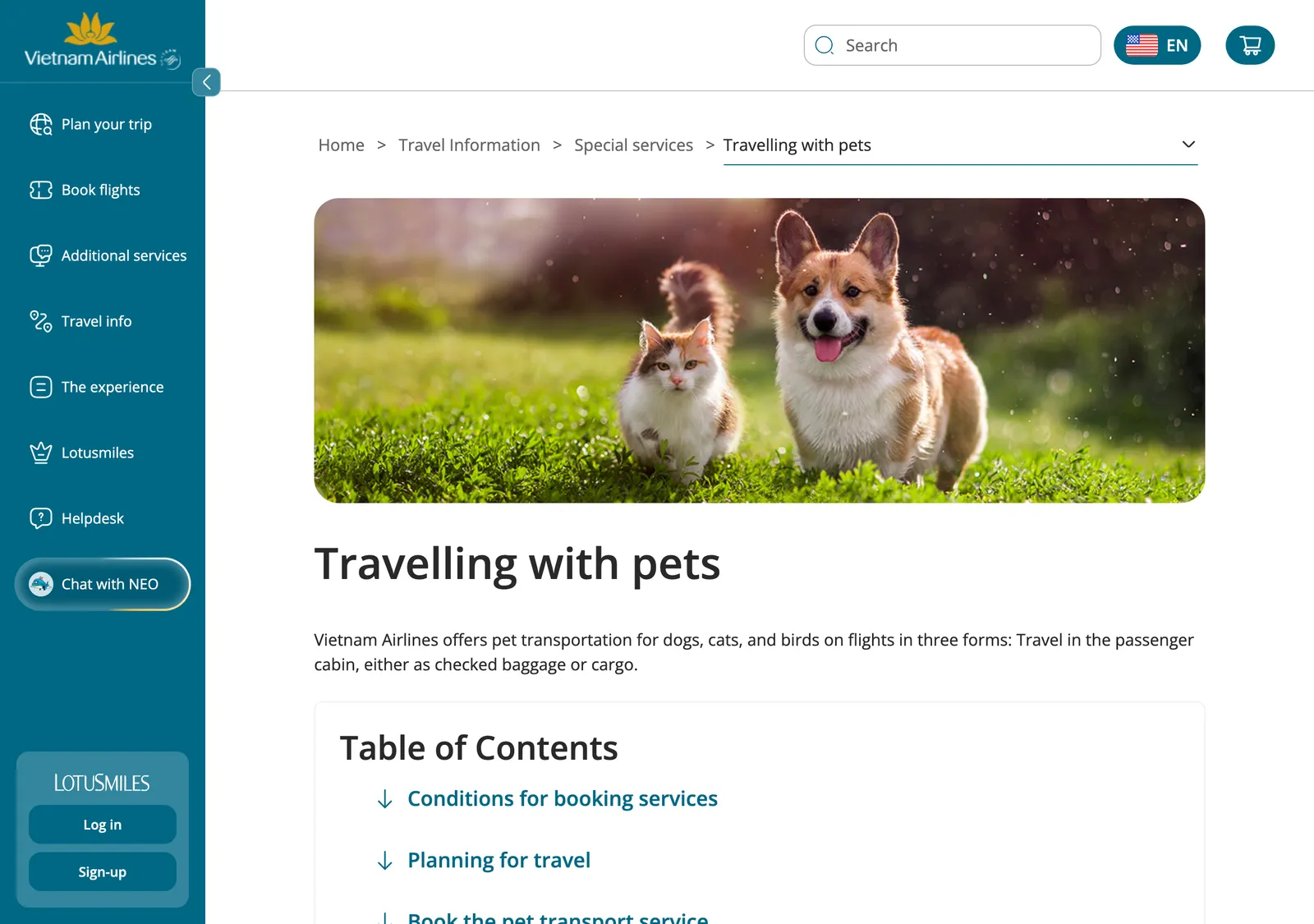
Separately from the quarantine rules above, your airline sets its own conditions for carrying the animal on the flight.
Vietnam Airlines, for one, accepts dogs and cats aged 10 weeks or older in the passenger cabin; it does not accept pet birds in the cabin. It does not transport dogs on flights between Vietnam and the United States. In the cabin, the pet and carrier together must weigh no more than 6kg, and the carrier must not exceed 35cm x 30cm x 20cm.
A pet in the cabin must also be healthy and fully vaccinated.
On Vietnam Airlines, dogs, cats 10 weeks or older and ornamental birds can also travel as checked baggage, as long as the pet and cage together don’t exceed 32kg.
The airline says taking a pet on board depends on each country’s legal and quarantine systems. It asks passengers to read the government rules of both the departure and arrival countries. These are the airline’s own carriage conditions, not a government quarantine requirement, so check directly with your carrier before booking.
Vietjet’s pet-in-cabin service is listed for Vietnam domestic flights, in every class except Business. Ask Vietjet about pets on an international ticket. On Vietjet, the pet must be at least 10 weeks old, and pregnant pets are not allowed. Cage and pet together may weigh up to 7kg, and the cage size is 35cm x 30cm x 20cm.
Each Vietjet flight takes at most 3 cages, with 1 pet per cage and 1 pet per passenger.
The cage sits on the floor in front of your seat, never on the seat. Vietjet charges VND 4,000,000 per cage with its pet, excluding VAT; ask Vietjet whether that applies to each flight.
Marrying a Vietnamese citizen as well? See registering a marriage in Da Nang. Once your pet has landed, see vets in Da Nang for clinics, hours and prices. For more on family logistics in Da Nang, browse the family guides hub.
Step by step
- Get an export quarantine certificateBefore you fly, get a quarantine certificate from the competent authority of your departure country. The animal must be healthy. It must come from an area or facility recognised as disease-free, or free of dangerous diseases, under World Organisation for Animal Health (WOAH) and Vietnamese rules. The certificate must meet Vietnam's veterinary hygiene requirements.
- Check whether you need advance registrationNo more than 2 animals kept for ordinary purposes are declared directly at the border. Bringing more than 2 requires sending a registration dossier (application form 19) to the Department of Livestock Production and Animal Health before you import.
- Wait for written consent and send the declaration, if you registered in advanceThis applies once you're past the up-to-2-animals case. The Department sends written consent and quarantine instructions within 4 working days of receiving a complete, valid file. After that, and before the animal reaches the border checkpoint, you send a declaration file to the border animal quarantine agency. You are also responsible for arranging a place for the animal's quarantine isolation.
- Declare at the border checkpoint on arrivalFor no more than 2 ordinary animals, declare the import quarantine directly with the border animal quarantine agency when you land.
- Pass the border checkThe agency checks your export certificate, examines the animal, vaccinates it if it isn't already protected against dangerous diseases, and samples it if an infectious disease is suspected.
- Get your import quarantine certificateIssued within 1 working day of the quarantine being carried out if no sample is needed, or within 5 working days if one is tested. This needs a complete file, a healthy animal vaccinated as required and, if a sample is tested, a negative result.
- Pay the feeVND 40,000 for the certificate, currently 50% of that rate through 31 December 2026. The same fee schedule lists a clinical-examination fee of VND 100,000 per motor vehicle or specialised vehicle for dogs and cats. It does not say how that applies to a pet carried by an air passenger.
Not confirmed: Rabies timing, microchip and certificate dates: ask the Department of Livestock Production and Animal Health, your departure vet authority and your airline. Whether Da Nang airport handles pets, where the desk is, and if the VND 100,000 exam fee applies: ask Regional Animal Health Office IV.
Common questions
How many pets can I declare directly at the border, without registering in advance?
Up to 2 animals in total, kept as pets, for family life, or travelling with you on holiday, business or in transit, and not on the banned list. Such an animal is declared directly to the border animal quarantine agency on arrival. It still needs the exporting country's quarantine certificate, which that agency checks.
What documents do I need before flying with my pet to Vietnam?
The animal must be healthy. It must come from an area or facility recognised as disease-free, or free of dangerous diseases, under World Organisation for Animal Health (WOAH) and Vietnamese rules. It needs a quarantine certificate from the exporting country's competent authority that meets Vietnam's veterinary hygiene requirements.
Do I need to register in advance if I'm bringing more than 2 pets?
Yes, under the standard import-quarantine registration process. You send form 19 to the Department of Livestock Production and Animal Health before you import. Written consent and instructions follow within 4 working days of a complete file. Then, before the animal reaches the border checkpoint, you send a declaration file to the border agency and arrange the quarantine isolation place yourself.
What happens when I arrive at the airport with my pet?
The border animal quarantine agency checks your export certificate and carries out a clinical exam. It vaccinates the animal if it isn't already protected against dangerous infectious diseases. It takes a test sample if the animal is suspected of an infectious disease.
How much does it cost to import a pet dog or cat into Vietnam?
The import quarantine certificate itself costs VND 40,000 per issuance, billed at 50% of that rate through 31 December 2026. The same fee schedule lists a clinical-exam fee of VND 100,000 per motor vehicle or specialised vehicle for dogs and cats. It does not say how that applies to a pet carried by an air passenger.
Does Vietnam set a specific rabies-vaccination timing or require a microchip?
The border checks for travellers do not mention a rabies-vaccination day count or a microchip. The export certificate must meet Vietnam's veterinary hygiene requirements, so ask the Department of Livestock Production and Animal Health before you fly. If an animal is not vaccinated against dangerous infectious diseases, the border agency vaccinates it but issues the certificate only if it is vaccinated as required. Your airline may set its own rules.
What if I don't declare my pet at the border?
Not registering or declaring quarantine on import is fined VND 4,000,000 to 5,000,000.
Can I bring my pet in the cabin with me on Vietnam Airlines?
Vietnam Airlines accepts dogs and cats aged 10 weeks or older in the cabin if the pet and carrier together weigh no more than 6kg. The carrier must also not exceed 35cm x 30cm x 20cm. That's the airline's own carriage rule, not a government quarantine requirement. Check with Vietnam Airlines whether it covers your route; on another airline, ask that carrier.
Read next
Sources and reader comments
Official legal texts (Gazette, government portals):
- Circular 01/2026/TT-BNNMT (Ministry of Agriculture and Environment) — animal quarantine, incl. animals carried by travellers (opens in a new tab)
- Law on Animal Health 79/2015/QH13, as amended (consolidated text — Văn bản hợp nhất 80/2026/VBHN-VPQH, Office of the National Assembly) — Điều 44 (requirements for imported animals), Điều 46 (import quarantine registration) (opens in a new tab)
- Circular 101/2020/TT-BTC (Ministry of Finance) — veterinary work fees and charges (opens in a new tab)
- Circular 64/2025/TT-BTC (Ministry of Finance) — temporary 50% cut on a list of fees, incl. two veterinary fees (opens in a new tab)
- Decree 204/2026/NĐ-CP (Government) — administrative penalties in veterinary work, replacing Decree 90/2017/NĐ-CP from 1 Aug 2026 (opens in a new tab)
Show 4 more sources
- Cục Chăn nuôi và Thú y — official website (page footer) (opens in a new tab)
- Cục Chăn nuôi và Thú y — Chi cục Thú y vùng IV (official unit page) (opens in a new tab)
Company and press pages (not official sources):
General information checked against the sources listed above, not legal advice for your situation. Rules and office practice change; confirm with the immigration office or a licensed adviser before you act. See how guides are checked.
Spotted an error? Report it.
Comments (3)
Nicoletravels__
What export paperwork do I need to bring my cat to another country? I’m bringing my kitten from Vietnam to Canada. I know what he needs to get to Canada and I’ve already sorted that. But apparently he needs an export permit from Vietnam. I was wondering if anyone in here had experience with that, and if so, how did you do it? Where do I go? How much does it cost? We are flying on December 3rd, so when should I go how? How long does it take? Another thing, my kitten is from Da Nang but we are flying to Toronto from HCM. So does he need a permit from da Nang or HCM?
GuiltyAd3142
Bought my cat back to the US from Vietnam. Any regional animal health department that works under the department of animal health could issue you the permit, so search for one closest to you. Don’t know the cost now but when I did it, it was 100k vnd for one permit. Make sure your cat got microchip, and all rabies vaccination up to date, bring all the paperworks, including your passport, identification and you should be fine. Got the permit same day, waited a little bit.
RAHDXB
No you can't just bring it in. I moved to Vietnam with a cat, and needed a bunch of vaccinations and certificates. It's so long ago, I can't remember exactly what it was, so hopefully someone else can help you with that. What I do always hear, is that bringing it in is a pain, but taking it out again (if your stay here is temporary) is way, way harder and would cost a lot of money.