How to Extend a Visa in Da Nang: Step by Step (2026)
Extending a stay in Da Nang means a sponsor files form NA5 with the immigration office — not NA6, which is for a different procedure, a temporary residence card. File the wrong form, or leave it too late, and the result is the same: an overstay, fined from 500,000 VND under Decree 282/2025/NĐ-CP once your permitted stay runs out.
Two procedures, one common mix-up
“Extending a visa” in Da Nang usually means gia hạn tạm trú: pushing out the dates on the stay already granted. That is a different procedure from a temporary residence card (thẻ tạm trú), a physical card some foreigners hold instead of extending repeatedly. The forms don’t overlap: a stay extension runs on form NA5, a residence card runs on NA6, NA7 or NA8. English translations flatten both into “temporary residence”, and that is exactly how guides end up sending readers to the wrong form.
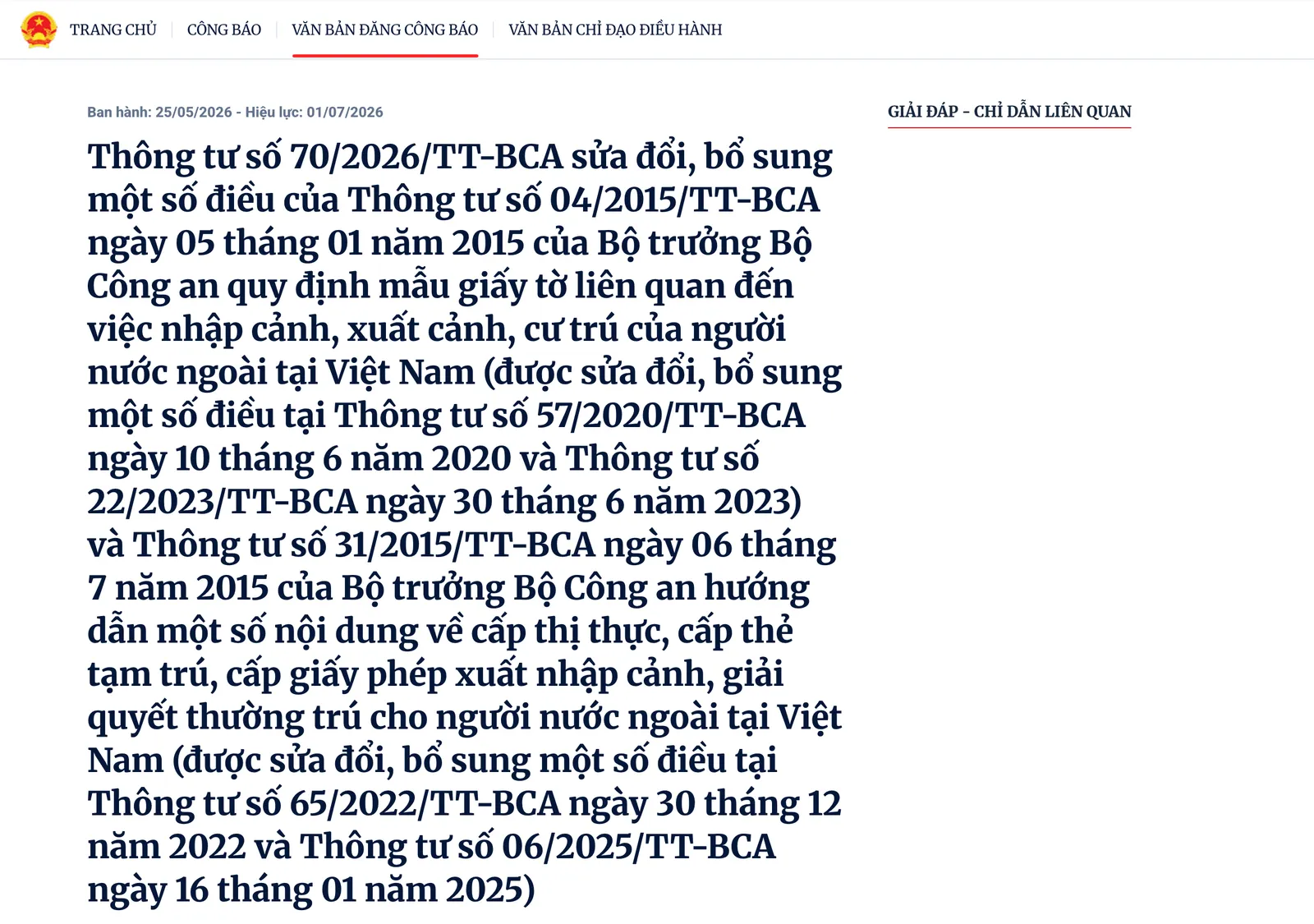
The NA5 form itself changed partway through this year. Circular 70/2026/TT-BCA, in force since 1 July 2026, revised the NA-series forms, NA5 among them. The Gazette listing below shows the circular’s title and dates; the clause that revises NA5 sits inside the circular’s own text, further down the page than this screenshot goes — exactly the kind of detail a form download page lags behind.
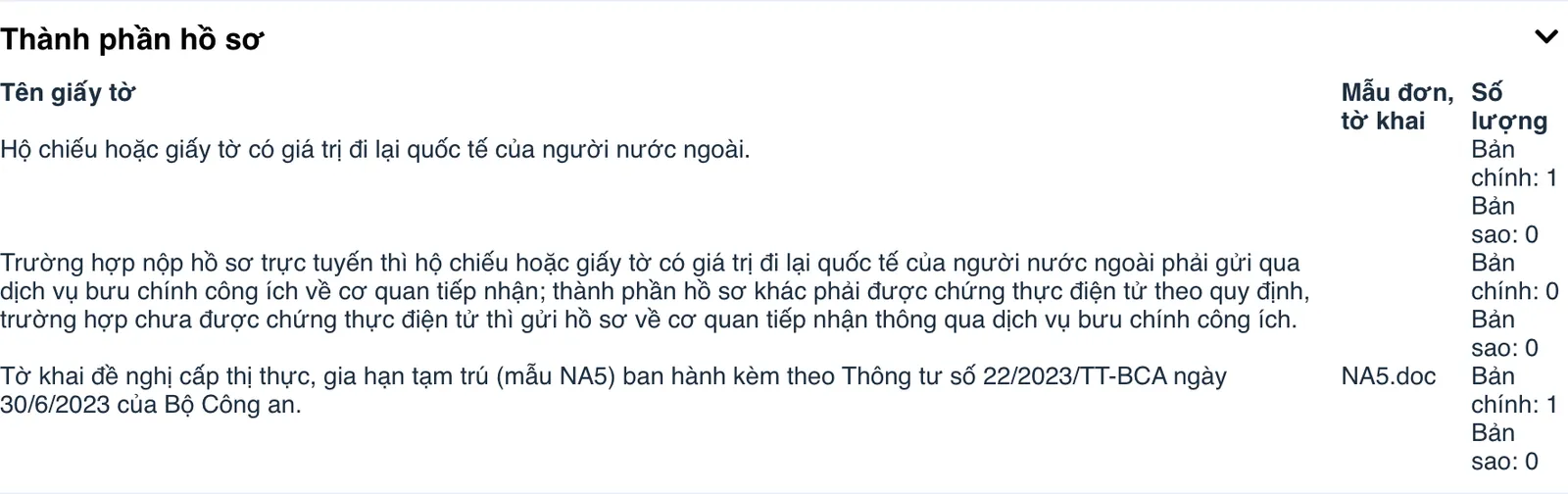
The ministry’s own procedure page hasn’t caught up yet. Its dossier list still names NA5 as the form issued with Circular 22/2023/TT-BCA, so a form downloaded from there may be the pre-July version.
No route that starts with you alone
Article 35(1) of Law 47/2014/QH13 puts the request in the hands of the organisation or individual that invited or sponsored you. The clause does not carve out an exception for any entry type: a tourist on a DL or EV visa of up to 90 days and a foreign employee on a business or labour visa file under the same requirement. Your sponsor is a Vietnamese employer or relative who files directly, or an agency that supplies the sponsoring entity and handles the paperwork for a charge on top of the government fee. A Vietnamese friend can’t do it: procedure 1.001146 limits individual sponsors to a grandparent, parent, spouse, child or sibling, with proof of the relationship. Both routes are lawful; what differs is who does the filing and what it costs beyond the fee itself. I compare the two routes, and what an agency typically charges, in agent vs DIY for a visa extension.
The clock: five working days once your file is complete
Once your sponsor’s file is complete, Article 35(3) gives the immigration authority up to 5 working days to decide. That figure comes from the law itself, and it matches what procedure 1.001146 states on the Ministry of Public Security’s portal. “Complete” is doing real work in that sentence — the clock starts once the passport, the current NA5 form and any supporting documents are all in, not on the day you first show up. A missing document or a public holiday both push the window back.
Filing takes place in person at the Da Nang Immigration Office, online through the same portal, or by post, with the result returned the same way.
78 Lê Lợi, Hải Châu, Đà Nẵng · Open in Google Maps
What it costs, and what you don’t get back
The government fee for a stay extension is 10 USD, set by Circular 28/2026/TT-BTC. See the full immigration fee table for how that compares with a new visa or a residence card. Article 6(3) of the same circular is worth reading before paying, not after: the fee already collected is not refunded if the application does not qualify or the applicant declines the result. A rejected file still costs 10 USD.
The same portal page is also a reminder to check current rules against the primary text rather than a single page: its legal-basis section still cites Circular 25/2021/TT-BTC, superseded by Circular 28/2026/TT-BTC on 1 April 2026. Agency pages carry their own version of the same lag — one agency guide advertises 5 to 10 working days for processing, wider than the 5 working days the law sets, and another names only business visas and the 5-year visa-exemption certificate as eligible for extension, narrower than what Article 35 actually says.
What’s not settled: e-visas, exemptions, and how long one extension lasts
Two things come up constantly and neither has a clean official answer. The first is whether an e-visa holder, or someone who entered visa-free under the 45-day exemptions for citizens of 12 named countries or a separate list of 12 European countries, can extend at all. Article 35 doesn’t distinguish by entry type, and the official eligibility wording asks only for a valid passport, a visa (or an exemption from one), and proof of temporary residence — wording that doesn’t exclude either group on its face, but no document or government source spells out these cases by name. The second is how long one extension actually lasts: the procedure page lists no maximum. A 6-month figure does exist in the rules, but it belongs to a narrower route — the 5-year visa-exemption certificate for overseas Vietnamese and their relatives, which carries a 6-month temporary residence certificate per entry and can be extended up to 6 further months with a sponsor. That is a different procedure from the general stay extension this guide covers.
If you run out of time
Missing the deadline turns a paperwork task into an overstay, priced by length under Decree 282/2025/NĐ-CP, Article 21, in force since 15 December 2025, which replaced Decree 144/2021/NĐ-CP.
A newer decree, 347/2026/NĐ-CP, took effect on 15 September 2026 and amended other articles of Decree 282/2025 — the overstay penalty article was not among them, so the bands above still apply. The fine itself is a range an officer sets within the band, usually starting at the midpoint before adjusting for the circumstances, and it climbs steeply with each threshold. None of this is a reason to file at the last moment; a few days of buffer before your current stay ends costs nothing. For everything else this cluster covers, see the visas and residence hub.
Step by step
- Confirm you have a sponsorLaw 47/2014/QH13, Article 35(1) requires the Vietnamese organisation or individual who invited or sponsored you to file the request — there is no procedure for a foreigner to apply alone, whatever visa or exemption is stamped in the passport.
- Settle who that sponsor isYour sponsor is the organisation or individual who invited or is sponsoring you: an employer, a Vietnamese relative, or an agency acting as sponsor of record. A friend does not qualify as an individual sponsor. If a Vietnamese citizen is sponsoring a relative, procedure 1.001146 requires proof of the relationship: grandparent, parent, spouse, child or sibling.
- Get the current NA5 formForm NA5 was revised by Circular 70/2026/TT-BCA, in force since 1 July 2026. Some official download pages still carry the pre-July version — take the current form from wherever you actually file, and pair it with your valid passport.
- Choose how to fileProcedure 1.001146 accepts filing in person at the Immigration Management Division, online through the Ministry of Public Security's portal, or by post, and the result can also be returned by post.
- Pay the 10 USD government feeThe fee under Circular 28/2026/TT-BTC is 10 USD per application. Article 6(3) of the same circular says it is not refunded if the file is refused or the result is declined, so it is charged whether or not the extension is approved.
- Wait out the processing windowArticle 35(3) of Law 47/2014/QH13 gives the immigration authority up to 5 working days once your sponsor's file is complete. A missing document or a public holiday both push that window back, since the clock starts on a complete file, not the day it is dropped off.
- Collect the result before your current stay endsPick up the extended dates in person or by post, and check the new expiry against your current permitted stay. Filing early enough to absorb a delay avoids turning a slow file into an overstay.
Common questions
What form is used to extend a visa in Da Nang?
Form NA5, plus your passport. NA5 is the form used for a stay extension under Law 47/2014/QH13, Article 35. NA6, NA7 and NA8 are different forms, used for a temporary residence card — a separate procedure that issues a physical multi-year card instead of extending your current dates.
How long does a visa extension take in Da Nang?
Up to 5 working days from the date your sponsor's file is complete, per Law 47/2014/QH13, Article 35(3). That is a ceiling set by law, not a guarantee. Some agency guides advertise 5 to 10 working days instead, which is wider than what the law actually sets.
Can I extend a visa without a Vietnamese sponsor?
No. Article 35(1) puts the request in the hands of the organisation or individual that invited or sponsored you — there is no procedure for filing alone. A Vietnamese citizen sponsoring a relative must show proof of the relationship: grandparent, parent, spouse, child or sibling.
Can e-visa or 45-day visa-exemption holders extend their stay?
No document or government source says yes or no. Article 35 does not distinguish by entry type, and the procedure's eligibility wording covers anyone with a passport, a visa (or an exemption from one), and proof of temporary residence — but nothing spells out these two entry types by name.
How much does a visa extension cost, and is it refundable?
10 USD, under Circular 28/2026/TT-BTC. Article 6(3) of that circular states the fee already collected is not refunded if the application does not qualify or the applicant declines the result — so it is worth confirming eligibility and paperwork before paying, not after.
What happens if I miss the deadline and overstay while sorting out an extension?
A fine that rises with length, from 500,000 to 2,000,000 VND under 16 days up to 30,000,000 to 40,000,000 VND for over a year, under Decree 282/2025/NĐ-CP, Article 21. Deportation may also apply to an overstay of more than 16 days, but it is discretionary, not automatic.
General information checked against the sources listed above, not legal advice for your situation. Rules and office practice change; confirm with the immigration office or a licensed adviser before you act. How these guides are checked: about Da Nang Oi.