Visa Run from Da Nang: What the Law Says About Re-Entry (2026)
Current law drops the old 30-day gap between exits and re-entries. A visa run is not illegal, but entry can still be refused in listed cases, such as forged papers. From Da Nang, you can re-enter visa-exempt (45 days on the unilateral lists), get a new e-visa for up to 90 days, or extend through a sponsor.
On this page
Vietnam’s entry law no longer sets any minimum gap since your last exit for a visa-exempt re-entry — the original 2014 law’s 30-day rule was dropped when Law 51/2019/QH14 rewrote Điều 20, leaving a 6-month passport-validity rule as the only extra condition for visa-exempt entrants. That does not make every re-entry automatic: Article 21 still lists cases where entry is refused, such as forged papers or a false declaration to obtain an entry or residence document. From Da Nang, the practical choices are: leave and come back on a fresh entry, or extend the stay you already have.
Does the law limit back-to-back entries?
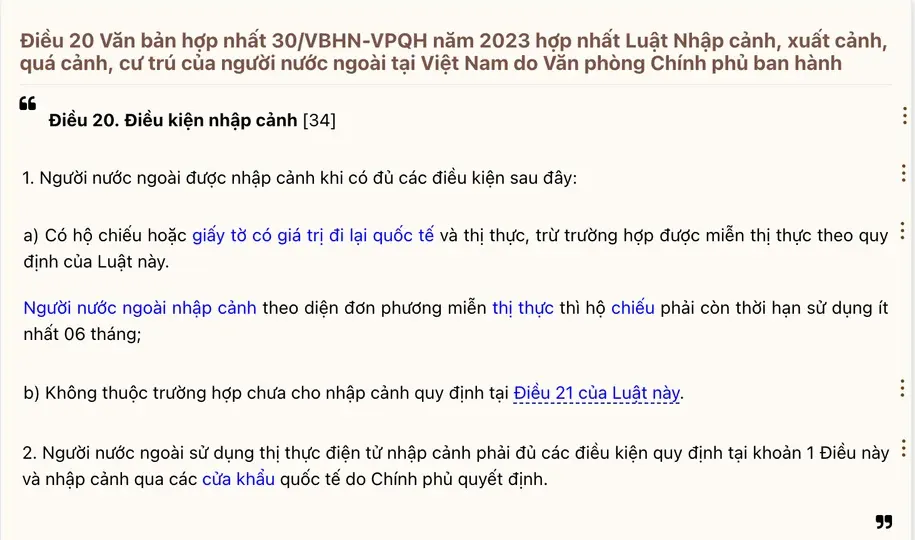
The article above, Điều 20, is the one that used to require a 30-day gap since your last exit for anyone entering under unilateral visa exemption. Law 51/2019/QH14 replaced the article wholesale, and the replacement text keeps only the 6-month passport-validity condition. Neither Law 23/2023/QH15 nor Law 118/2025/QH15 touches this article either — the entry-conditions text in force today is the same one Law 51/2019/QH14 wrote.
What a new entry gives you
A new e-visa is valid for up to 90 days, single or multiple entry, costs US$25 for a single-entry visa or US$50 for a multiple-entry visa, and is filed by you directly through the government e-visa portal, entirely online. Since Resolution 127/NQ-CP took effect, the scheme covers citizens of every country and territory, not just a shortlist. It only works at the border gates the Government has designated for e-visa use. For eligibility and cost details beyond a visa run, see Vietnam E-Visa: Eligibility, Cost and How Long It Lasts.
If your country is on one of Vietnam’s unilateral exemption lists instead, entering visa-exempt gives you 45 days from that entry, a figure set by Law 23/2023/QH15 itself, issued at the border with no filing at all. Exemptions under bilateral agreements, such as those with most ASEAN neighbours, are separate and carry their own stay lengths. Which countries qualify is a separate decision the Government makes for each country under Điều 13, valid for up to 5 years at a time. Two resolutions currently list who qualifies: one covers 12 countries, valid from 15 March 2025 to 14 March 2028; the other covers a separate 12 European countries for tourism only, valid from 15 August 2025 to 14 August 2028. See Vietnam Visa Exemption Countries in 2026 for the full lists.
Border gates near Da Nang that take e-visas
For Da Nang specifically, e-visas are accepted at Da Nang International Airport and at Da Nang seaport, both listed since Resolution 127/NQ-CP in 2023. Nam Giang, the Laos land crossing that is now administratively inside Da Nang city, was added to the e-visa gate list in December 2025 by Resolution 389/NQ-CP, corroborated separately by a press report of the same addition. Lao Bao, another Laos crossing, has taken e-visas since 2023 too, but it sits in Quang Tri province, not inside Da Nang. Whether Nam Giang is actually staffed for routine, day-to-day tourist e-visa processing — not just designated on paper — is unconfirmed; no source found for this guide describes its operating hours or capacity.
Extending instead of leaving
Extending your stay in place, rather than leaving and coming back, means your sponsor files the paperwork, not you — see How to Extend a Visa in Da Nang for the process, documents and current fee.
Can immigration refuse you at re-entry?
Yes, in the cases Article 21 lists, for example forged papers or a false declaration made to obtain an entry, exit or residence document. A past deportation or forced exit can also bar re-entry for a set period; see Vietnam Visa Overstay Fine. Whether a pattern of frequent, back-to-back entries draws extra scrutiny in practice is not addressed by any law or government source found for this guide.
Not confirmed: Whether immigration flags a pattern of frequent, back-to-back entries is not addressed by any law or government source found for this guide; visa-run agencies describe it merely as unwritten officer discretion, not a legal rule. Whether the Nam Giang border gate is actually staffed for routine day-to-day e-visa processing, rather than only designated on paper, is also unconfirmed.
Common questions
Is doing a visa run from Da Nang actually legal?
Yes, as far as the entry rules themselves go: the 30-day gap since your last exit that the original 2014 law required was dropped when Law 51/2019/QH14 rewrote Điều 20. Entry can still be refused for forged documents or a false declaration.
Which border crossing near Da Nang accepts e-visa holders?
Da Nang's international airport and seaport have taken e-visas since 2023. Nam Giang, now inside Da Nang city, was added to the e-visa gate list by Resolution 389/NQ-CP in December 2025. Whether Nam Giang is actually staffed for routine tourist processing day to day is unconfirmed.
How long can a new e-visa keep me in Vietnam, and what does it cost?
Up to 90 days, single or multiple entry, for US$25 or US$50, filed by you online through the government portal.
What if my passport is on the 45-day visa-exemption list instead?
You get a 45-day stay stamped at the border with no filing at all — but only for the countries the Government has separately listed under Resolution 44/NQ-CP or Resolution 229/NQ-CP, and the European-country resolution only covers tourism.
Do I have to leave the country to stay longer, or can I extend instead?
You can extend without leaving, but your sponsor has to file it for you, not you yourself — the site's guide to extending a visa in Da Nang covers the process and fee.
Can immigration stop me from doing repeated visa runs?
No law or government source found for this guide sets a limit on repeat re-entries. The refusal grounds in Article 21 are specific cases, such as forged papers or a false declaration to obtain an entry or residence document. Whether repeated back-to-back entries draw extra scrutiny in practice is not addressed by any source for this guide.
Next in Visas & residence
General information checked against the sources listed above, not legal advice for your situation. Rules and office practice change; confirm with the immigration office or a licensed adviser before you act. How these guides are checked: about Da Nang Oi.