Is It Safe to Swim in Da Nang? Beach Flags, Hours and Rip Currents
Stay inside the buoyed area marked by yellow-red flags and follow the on-duty lifeguards. Don't swim after the end of duty hours is announced. Don't swim in bad weather or rough seas. From 15 March to 30 September, the beach management board's 2023 notice set duty hours of 4:30am–7:00pm, with peaks at 4:30–7:30am and 3:00–7:00pm.
On this page
Swim only inside the buoyed area marked by yellow-red flags, where on-duty lifeguards can see you, and get out when the end of duty hours is announced. Stay out of the water in bad weather or rough seas. From 1 October to 14 March, lifeguard peak hours are 5:00–7:30am and 3:00–6:30pm, so the safest swim is in those windows.
Those signs matter, because around 5:15pm on 18 May 2024 a drowning at the beach access at the end of Ho Xuan Huong Street left 2 people dead and 1 missing. It was in what was then Khue My Ward, and the beach management board said the area where the victims were swept away already had a danger sign prohibiting swimming. Here are the board’s rules on flags, lifeguard hours and rip currents.
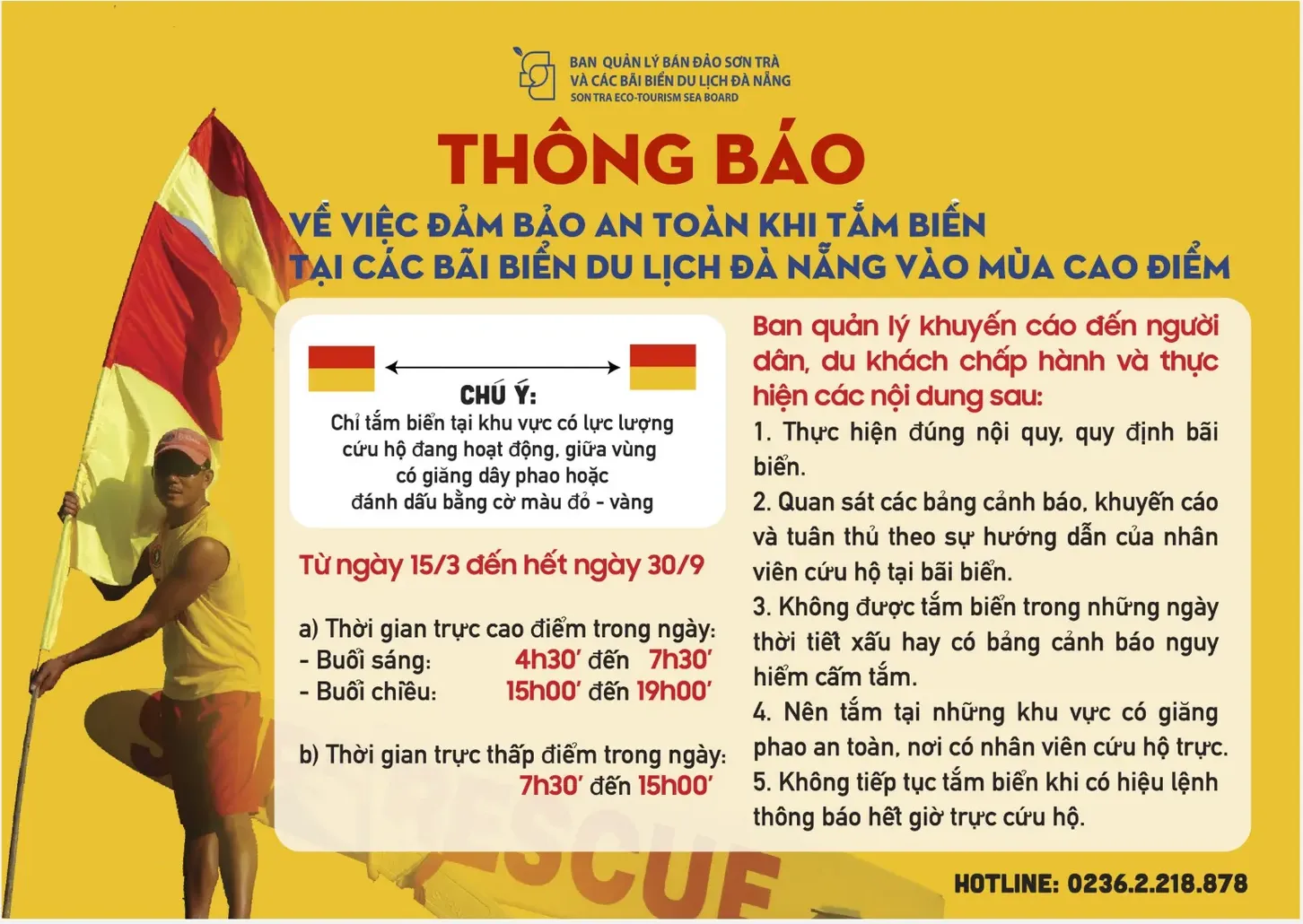
What the flags and signs mean
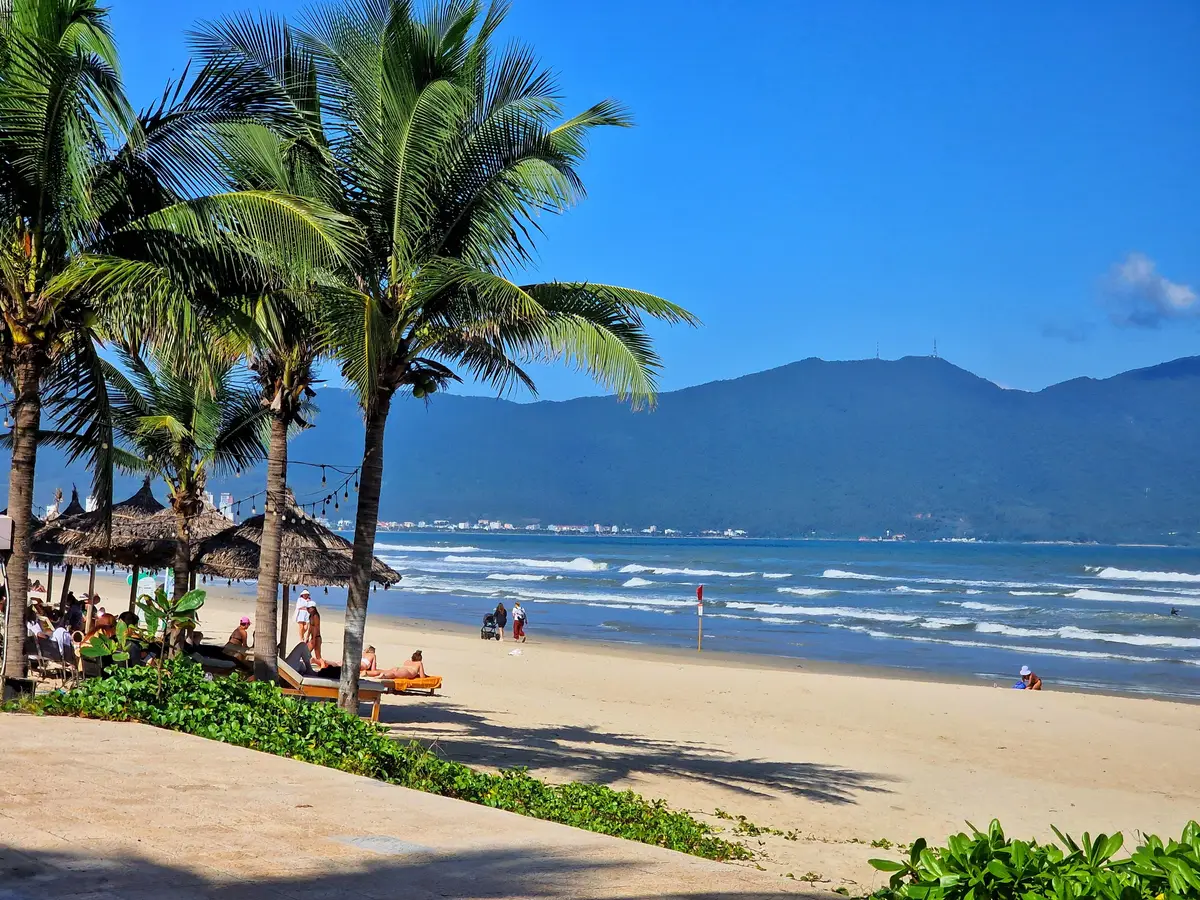
Rules for swimmers:
- Swim only inside the area marked off with safety buoys and identified by yellow-red flags, and follow the on-duty lifeguards’ instructions.
- Don’t keep swimming once the end of duty hours is announced.
- Don’t swim on days of bad weather, rough seas or big waves.
- Don’t swim where a sign posts a danger warning and prohibits swimming.
Yellow-red flags mark the buoyed swimming area. A posted danger sign means no swimming. Any other flag colour is unexplained, so follow the on-duty lifeguards’ instructions.
The Rescue Team’s mandate includes studying and proposing signs. The signs mark the area safe for swimming, an unsafe area, whirlpool areas and dangerous no-swim areas, so bathers can recognise and avoid risk.
Lifeguard hours
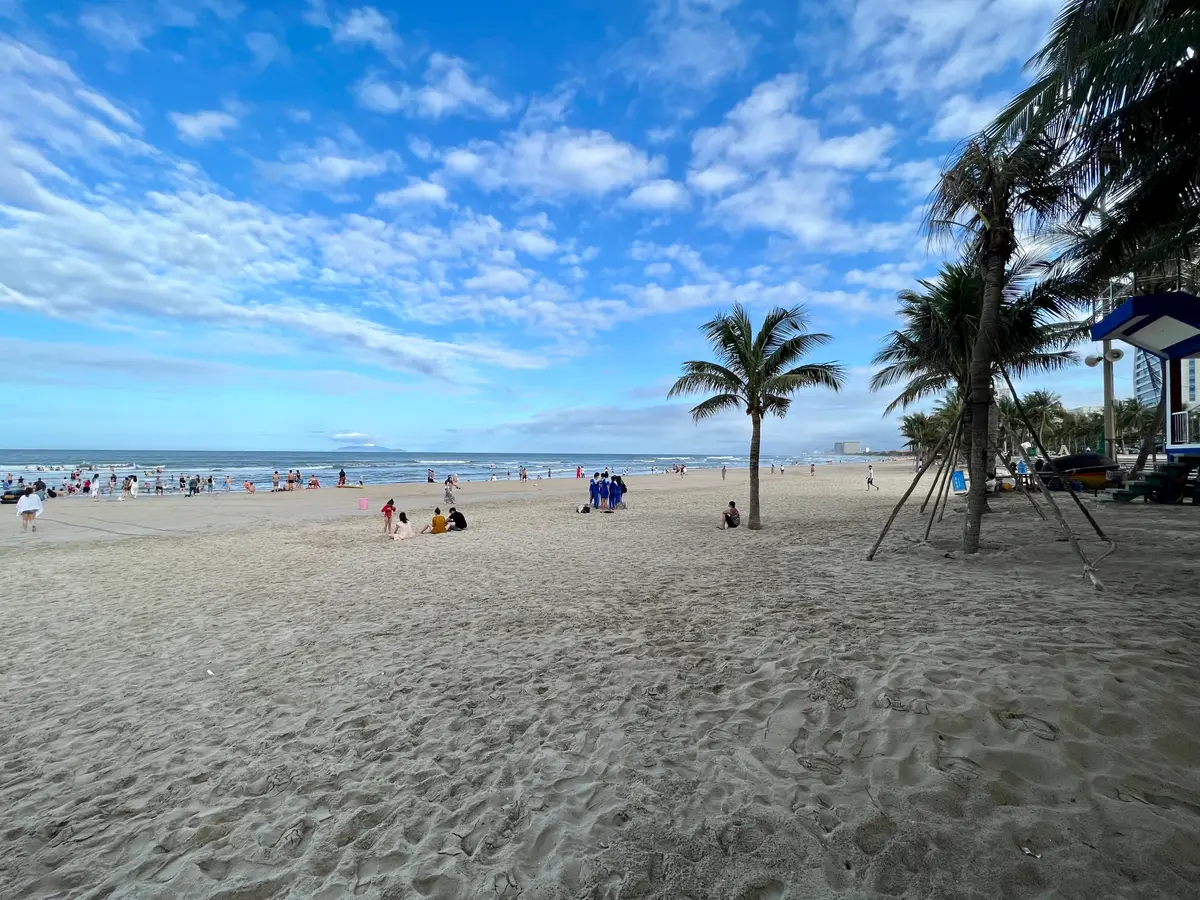
A Management Board notice posted 24 March 2023 set these duty hours. Lifeguards are on duty in both the peak and the low-traffic periods.
- 15 March to 30 September: peak 4:30–7:30am and 3:00–7:00pm; low-traffic 7:30–11:30am and 11:30am–3:00pm.
- 1 October to 14 March: peak 5:00–7:30am and 3:00–6:30pm; low-traffic 7:30–11:30am and 11:30am–3:00pm.
Outside these hours no lifeguards are on duty. A peak-season notice posted 3 June 2024 repeated only the 15 March to 30 September hours.
A 2022 notice said that from May through the end of August, the rescue team blows a whistle at 6:45pm to signal the end of duty hours, which comes before the afternoon peak period ends. Stop swimming once the end of duty hours is announced.
Rip currents
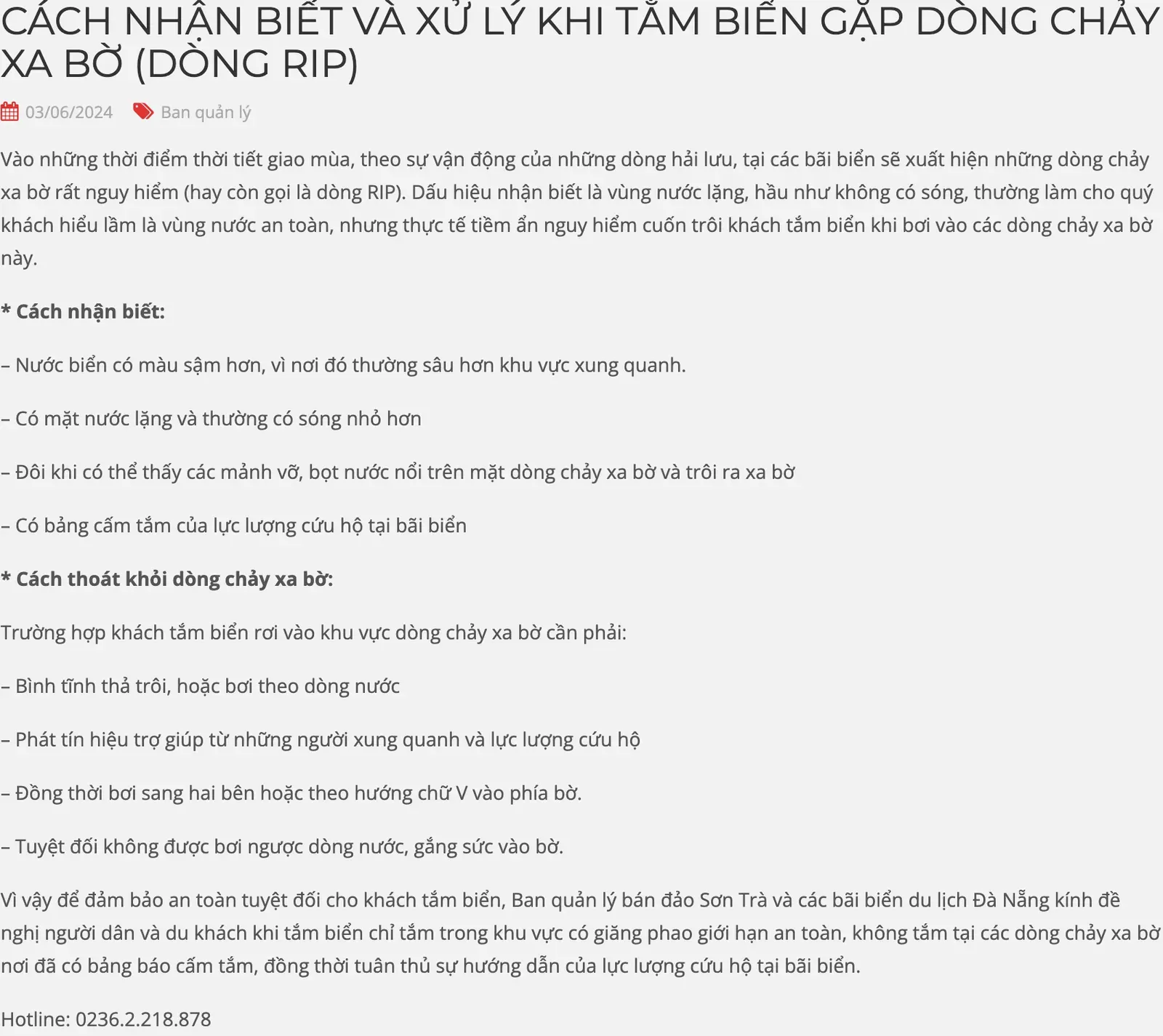
The board lists the signs of a rip current:
- The water looks darker than the surrounding sea, because it’s usually deeper there.
- The surface is calm, usually with smaller waves than the water around it.
- Debris or foam may be seen floating on the current and drifting out to sea.
- There may be a no-swimming sign from the lifeguard force at the beach.
A calm, darker patch among the waves is therefore a place to avoid, not a good spot to swim. A missing sign does not mean there is no rip current, because a no-swimming sign is only one of the warning signs the board lists.
If you’re caught in one:
- Stay calm and let the current carry you, or swim with the current, rather than fighting it.
- Signal for help from people nearby and the rescue force.
- At the same time, swim to either side or in a V-shape toward the shore.
- Never swim directly against the current, struggling toward the beach.
Only swim inside the area marked off with safety-limit buoys, and follow the on-duty lifeguard force’s instructions. Never swim in a rip-current area that already carries a no-swimming sign.
Who runs the beaches, and who to call
The Son Tra Peninsula and Da Nang Tourist Beaches Management Board was established under Decision No. 4694/QĐ-UBND (11 July 2006) of the Da Nang City People’s Committee. Its duties include carrying out rescue operations at Da Nang’s tourist beaches. Its posted rip-current guidance lists a hotline: 0236.2.218.878. For an ambulance or police, see Da Nang emergency numbers.
The board’s visitor rules list these duties for individuals:
- Strictly follow the Management Board’s regulations, the beach’s own rules and the on-duty lifeguards’ instructions.
- Cooperate with responsible staff and lifeguards, taking part in promptly rescuing anyone in danger when asked to.
- Help keep order and environmental cleanliness at the beach.
The city’s tourism portal published a set of criteria on 26 June 2020, titled “Professional Standard for Serving Guests at Tourist Beaches in Da Nang”. It calls for the specs below. Don’t assume every beach meets them.
- A safe-swimming corridor of buoys, boundary flags and warning signs, at least 150m long out to sea, with markers 50m apart, in a colour that contrasts with the water.
- At least one rules board, at least 6m² in size, at every beach access path, stating the rules in two or more languages including Vietnamese and English.
- Rescue-observation stations no more than 300m apart.
- At least one rescue boat, one rescue jet-ski and one radio set at each tourist beach.
Rules on the beach
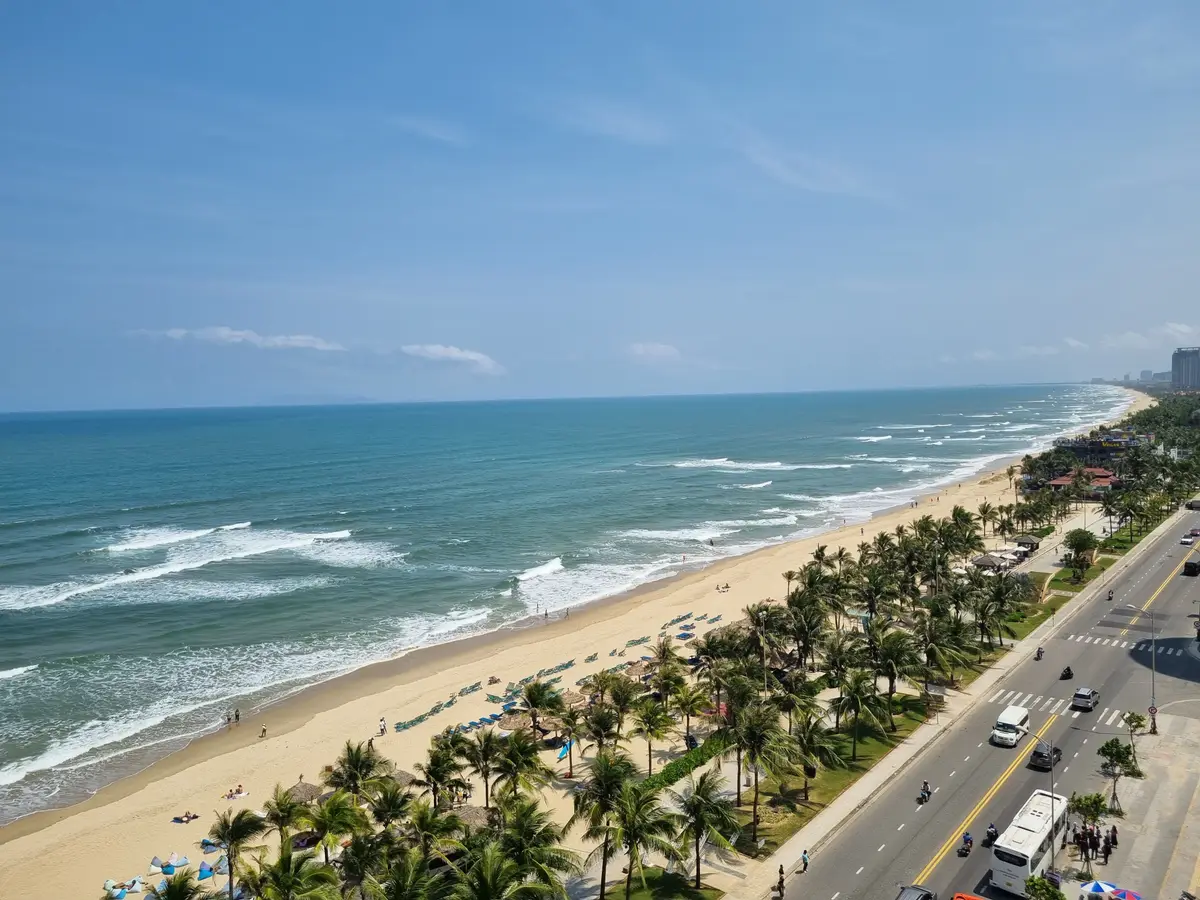
At Da Nang’s public beaches, the board’s visitor rules (posted 2019) say no individual or organisation may:
- Dump untreated waste into the sea, or litter outside designated bins.
- Beg, hawk goods, fight or disturb public order.
- Run unauthorised sports activities, play football, or herd or release livestock.
- Bring vehicles onto the beach.
- Run a business without the competent authority’s permission, or beyond what was permitted.
- Bring food or drink to eat in areas where a beach’s own rules don’t allow eating.
- Tap a well or borehole without the state management agency’s consent.
On some beaches being developed as model beaches, businesses are strictly forbidden from encroaching on the beach to set up umbrellas or chairs inside the area reserved for swimmers.
The board’s sea-tourism division inspects and proposes how to handle violations of the rules in three documents. They are a Da Nang City People’s Committee decision, the Scheme for Managing and Exploiting Da Nang’s Tourist Beaches, and the commitment contracts of bathing areas, parking points and vendors.
Storms and seasonal closures
On the afternoon of 6 November 2025, the Management Board announced a temporary halt to swimming and water-sports activities from 1:00pm that day until further notice, to keep residents and tourists safe given Typhoon No. 13’s complex developments. The rule against swimming in bad weather, rough seas or big waves applies even without such a notice.
In June 2024, a national forecasting official expected El Nino to turn neutral and then shift toward La Nina, with typhoon and tropical-depression activity likely to concentrate from July to September in Vietnam’s Northern and North-Central regions. It was likely to concentrate from October to December in the middle and southern parts of Vietnam’s central coast (Trung Trung Bo and Nam Trung Bo).
That was an outlook for that year, not a fixed calendar.
For which months matter for Da Nang, see Da Nang’s typhoon season, and for streets that flood after heavy rain, see Da Nang flooding streets.
Recent drownings
These are examples reported in the press, not a complete list.
In April 2024, twin siblings P.G.B. and P.B.T., both 14, drowned at the beach in what was then Hoa Hai Ward.
On the afternoon of 4 January 2025, two foreign tourists were swept away by waves while swimming in what was then Hoa Hai Ward. It was in front of a resort that the report names only by the initials N.A. Both tourists were brought to shore safely, but one resort rescue worker who took part in the rescue was swept away and went missing.
Photos (4)
- Creative Commons Attribution-ShareAlike 3.0 Unported (CC BY-SA 3.0 (opens in a new tab))
- Krys D
- Alex Duong
- dk
Not confirmed: Whether the lifeguard hours above still apply, as they come from notices dated 2022 to 2024. Whether the board's hotline is staffed around the clock or in English; in a medical emergency call 115. Whether flags other than yellow-red are used and what they mean; follow the on-duty lifeguards.
Common questions
What do the flags on Da Nang's beaches mean?
Swim only inside the area marked off with safety buoys and identified by yellow-red flags, and follow the on-duty lifeguards' instructions. A sign posting a danger warning and prohibiting swimming means don't swim there. Any other flag colour is unexplained, so follow the on-duty lifeguards' instructions.
What hours are lifeguards on duty at Da Nang beaches?
Under a notice posted 24 March 2023, from 15 March to 30 September lifeguards are on duty in peak periods (4:30–7:30am and 3:00–7:00pm), plus low-traffic periods (7:30–11:30am and 11:30am–3:00pm). From 1 October to 14 March, peak hours are 5:00–7:30am and 3:00–6:30pm, with the same low-traffic hours as above.
How do I recognise a rip current at a Da Nang beach?
The water looks darker than the surrounding sea, and the surface is calm, usually with smaller waves than the water around it. Debris or foam may be seen drifting out to sea. There may also be a no-swimming sign from the lifeguard force. A calm patch among the waves is therefore a sign of a rip current, not a good place to swim.
What should I do if I'm caught in a rip current?
Stay calm and let the current carry you, or swim with the current, rather than fighting it. At the same time, signal for help from people nearby and the rescue force, and swim to either side or in a V-shape toward the shore. Never swim directly against the current struggling toward the beach.
Which beaches does Da Nang's beach management board list?
Five appear under the board's "Beaches" menu: Nam O, Xuan Thieu, Pham Van Dong, My Khe and Non Nuoc. That is a website menu, not a list of lifeguarded or approved bathing areas.
Who do I call in a beach emergency in Da Nang?
For a medical emergency call 115. 112 is the search-and-rescue number. The hotline listed by the beach management board on its rip-current safety guidance is 0236.2.218.878. In the water, signal for help from people nearby and the rescue force. For police, see the Da Nang emergency numbers guide.
Has Da Nang closed its beaches to swimming during a storm before?
On the afternoon of 6 November 2025, the Management Board halted swimming and water-sports activities from 1:00pm that day until further notice, given Typhoon No. 13's complex developments.
Read next
Sources and reader comments
Official legal texts (Gazette, government portals):
- Ban quản lý bán đảo Sơn Trà và các bãi biển du lịch Đà Nẵng — "Thông báo về việc đảm bảo an toàn khi tắm biển vào mùa cao điểm" (peak-season safety notice) (opens in a new tab)
- Ban quản lý bán đảo Sơn Trà và các bãi biển du lịch Đà Nẵng — "Thông báo khung giờ trực của Đội Cứu nạn" (2023 lifeguard-hours notice) (opens in a new tab)
- Ban quản lý bán đảo Sơn Trà và các bãi biển du lịch Đà Nẵng — "Thông báo về việc quy định giờ trực cứu hộ tại các bãi biển du lịch Đà Nẵng" (annual lifeguard-hours notice) (opens in a new tab)
- Ministry of Information and Communications — Circular 27/2021/TT-BTTTT amending, supplementing and repealing several articles of Circular 22/2014/TT-BTTTT (Telecommunications Numbering Planning) — primary signed text, incl. its Phụ lục 3 (Bảng quy hoạch mã, số dịch vụ) which fully replaces the original Phụ lục 3 of Circular 22/2014/TT-BTTTT (opens in a new tab)
- Ban quản lý bán đảo Sơn Trà và các bãi biển du lịch Đà Nẵng — "Cách nhận biết và xử lý khi tắm biển gặp dòng chảy xa bờ (dòng RIP)" (opens in a new tab)
Show 10 more sources
- Ban quản lý bán đảo Sơn Trà và các bãi biển du lịch Đà Nẵng — sidebar widget and main-menu section "Các bãi biển" (site-wide, present on every article under "Du lịch biển"; checked on the "Bãi biển Mỹ Khê" page) (opens in a new tab)
- Ban quản lý bán đảo Sơn Trà và các bãi biển du lịch Đà Nẵng — "Quy định khi tham quan" (visitor/vendor rules at Da Nang's public beaches) (opens in a new tab)
- Ban quản lý bán đảo Sơn Trà và các bãi biển du lịch Đà Nẵng — "Đội cứu hộ" (Rescue Team mandate) (opens in a new tab)
- Ban quản lý bán đảo Sơn Trà và các bãi biển du lịch Đà Nẵng — "Giới thiệu" (about page: founding decision, mandate, contact numbers) (opens in a new tab)
- Danang Fantasticity (official city tourism-promotion portal, run by Đà Nẵng Dept. of Culture, Sports & Tourism / Danang Tourism Promotion Center) — "Bộ tiêu chí 'Chuẩn chuyên nghiệp trong phục vụ khách tại các bãi tắm du lịch trên địa bàn thành phố Đà Nẵng'" (opens in a new tab)
- Ban quản lý bán đảo Sơn Trà và các bãi biển du lịch Đà Nẵng — "Phòng quản lý và khai thác du lịch Biển" (Sea Tourism Management & Exploitation Division mandate) (opens in a new tab)
Company and press pages (not official sources):
- Báo Văn Hóa (baovanhoa.vn) — "Đà Nẵng tạm dừng hoạt động tắm biển để đảm bảo an toàn trước bão số 13", 6/11/2025 (opens in a new tab)
- Dân trí — "9 người bị sóng cuốn ở biển Đà Nẵng, 2 người tử vong, 1 mất tích", 19/5/2024 (opens in a new tab)
- Cổng TTĐT Chính phủ (xaydungchinhsach.chinhphu.vn) quoting Nguyễn Văn Hưởng, Trưởng phòng Dự báo thời tiết, Trung tâm Dự báo KTTV Quốc gia (NCHMF), on the Jul–Dec storm season for Vietnam's regions (opens in a new tab)
- Tuổi Trẻ — "Cứu người đuối nước trên biển Đà Nẵng, nhân viên cứu hộ bị sóng cuốn mất tích", 5/1/2025 (opens in a new tab)
General information checked against the sources listed above, not legal advice for your situation. Rules and office practice change; confirm with the immigration office or a licensed adviser before you act. See how guides are checked.
Spotted an error? Report it.
Comments (7)
MrFrydenlund89
Live close to the beach and go out without your phone and money with a towel is my solution. Or if you want to buy something bring a little bit of money but dont keep it in a wallet. Leave your stuff with your towel and hit the waters. Another thing to keep in mind about the beach in Da Nang is the currents. Its probably the most dangerous beach I have been to in South East Asia. Dont go swimming by yourself at night.
GKarTheRedKnight
Don't risk leaving valuables on the beach. It's not worth it. A lot of the time they will be there when you come back, some times they will not. There's always someone who will let temptation get the better of them. There are several places along My Khe that have locker facilities. Or, get a small 5L dry bag that you can keep on you. Also, those long distance inflatable swimming floats also have a waterproof pocket in them to keep things.
View all 7 comments
DrewDronesFPV
Yo! I just got back from there and I am by no means a local but talked to every surfer bro I could. If you go out with a surfboard, they won’t bother you, otherwise they will blow their whistle until your ears go deaf, I had to tell the lifeguards that I was going in and that I would be ok. The currents and rips are real, I grew up surfing, am a very confident swimmer and the first day I went out with a board I got smashed around for an hour and didn’t even end up catching a wave (did about 100 duck dives) I came out and met two French boogie boarders (locals of 8+ years) who told me that it’s not a time to be out and they also got drilled (was probably 2.5M faces). To be honest, just go talk to the lifeguard, tell them you are ok, show them some photos of you surfing and ask if you can go swim or like someone else recommended get a board and go out.
Infamous-Pickle3731
Tbh many tourists come here and don’t know how to swim, get caught in a rip current, and drown. In winter, the currents are really strong so they don’t typically allow swimming. However, if you have some type of raft (bodyboard, surfboard, life jacket) they’ll let you swim. I suggest renting one and the lifeguards won’t bother you
americaninsaigon
If they want you out of the water, they will blow a loud whistle otherwise it’s good
WilliamHillMerlot
The locals swim en masse for about 2 hours starting at dawn, and for about 2 hours before sunset.
pfffffffffft_tommy
There are designated swimming areas. Locals usual go early morning and late afternoon. If there are unsafe conditions such as a riptide, they won’t let you swim.